Guttate hypomelanosis. Preventing and treating white spots
Idiopathic guttate hypomelanosis is a pigmentation disorder that causes white spots on the skin. How can it be prevented and treated?
Small white spots. They appear by the dozen on the legs and forearms after sun exposure, dotting tanned skin. This is how idiopathic guttate hypomelanosis (or lenticular leucoderma) shows itself: a skin condition that is often mistaken for vitiligo but has an entirely different origin.
In the following lines, we will look together at what guttate hypomelanosis really is, which factors encourage the onset of this skin pigmentation disorder, how to prevent white spots from forming on the skin and which products to use to treat them once they have appeared.
Idiopathic guttate hypomelanosis: what it is and what the symptoms are
The small white spots typical of guttate hypomelanosis are the result of progressive damage to the melanocytes, the cells responsible for producing melanin. This pigment, which darkens our skin and gives us a tan, has a very specific function: it protects the skin's DNA from the harmful action of UV rays.
So, if the melanocytes do not work properly, these patches of lighter skin appear: small, porcelain-white, round or oval spots, resembling dewdrops or tiny snowflakes.
Usually, the spots caused by idiopathic guttate hypomelanosis are found on the legs, forearms and upper back, that is, on the areas of the body most exposed to sunlight.
The lesions are typically scattered and do not merge into large patches.
It is mainly a cosmetic problem, which can cause discomfort because of the disfiguring effect when the spots are numerous and spread over several areas.
Causes and predisposing factors: why do white spots appear?
The term "idiopathic" means that guttate hypomelanosis has no specific cause, or rather that, to date, it is not yet clear what triggers the onset of this skin disorder.
We do, however, know several factors that can contribute to the development of this particular condition:
- sun exposure
- ageing
- genetic predisposition
First and foremost is prolonged, unprotected exposure to UV rays.
As we pointed out in the article "The sun. Friend or foe of the skin?", solar radiation has harmful effects on the skin, because it can penetrate deeply and significantly alter the skin's DNA.
Long, unprotected exposure can therefore cause cumulative sun damage which, after several years, leads to a reduction in melanin production in some areas of the skin.
Skin ageing also plays a significant role in idiopathic guttate hypomelanosis, which appears more often in people aged 40 and over.
With advancing age, in fact, the skin undergoes certain physiological changes: it becomes thinner and less elastic, while cell renewal slows down and the melanocytes lose part of their functional capacity.
The decline of these mechanisms means that the skin is less and less able to regenerate and effectively repair the damage caused by the sun and other environmental agents.
Another factor to consider is genetics.
People with a family history of guttate hypomelanosis may be predisposed to developing the disorder.
Preventing idiopathic guttate hypomelanosis. How to avoid white spots on the skin
Precisely because of genetic factors, it is not always possible to prevent idiopathic guttate hypomelanosis.
However, we can take some countermeasures to minimise the risks and keep our skin healthy and beautiful for longer.
Since, as we have seen, the sun is one of the main culprits, using effective protection can help us avoid those unsightly little white spots that spoil the evenness of our skin.
Our advice is to use sun protection every day, applying it in the winter months too, when solar radiation is milder but still capable of damaging the skin.
On our website you will find two cutting-edge photoprotection products, suited to the needs of every phototype:
Both are formulated with a latest-generation complex patented by GD, DNA REACTIVATOR COMPLEX®, obtained by combining powerful active ingredients such as Phytoplankton extract and Polygonum aviculare extract with other selected broad-spectrum filters, which enable it to provide protective, preventive and repairing action against sun damage and oxidative stress.
Thanks to DNA REACTIVATOR COMPLEX®, the TANNISOL line products:
- protect and repair damaged DNA
- offer total coverage across the entire magnetic spectrum, screening out UVA, UVB, infrared and higher-energy blue light, which is responsible for light intolerance reactions and skin hyperpigmentation
- have an antioxidant action, fighting the free radicals that accelerate skin ageing and encourage inflammatory conditions.
As well as constant protection, a good tip is to keep your skin well hydrated at all times.
Hydration is, in fact, essential to preserve the integrity and health of the skin, which needs an adequate concentration of water to carry out all its fundamental cellular processes.
Properly hydrated skin is more elastic, toned and radiant.
Treating idiopathic guttate hypomelanosis. How to cover small white spots
Unfortunately, there is no definitive treatment for idiopathic guttate hypomelanosis.
But there are several options that can help make the white spots less noticeable and improve the appearance of the skin.
You can, of course, use creams and lotions that cover the discoloured areas, giving the illusion of an even complexion.
But it is also possible to act on pigmentation, helping the skin to produce melanin.
Naturally, before taking supplements or applying creams, it is always best to consult your trusted dermatologist for a diagnosis and treatment advice specific to your case.
If you suffer from white spots on your skin, you can ask your doctor or pharmacist whether these two products might help you: PIGMADIN SUPPLEMENT and MELANIDIN PLUS CREAM.
PIGMADIN is a food supplement formulated with plant-based actives, vitamins and minerals such as:
- Lycopene
- Antioxidant astaxanthin from Haematococcus pluvialis
- Methionine
- Black pepper and green tea with antioxidant properties
- Maca extract with a tonic and metabolic support action
- Selenium and riboflavin (Vit. B2), which contribute to the protection of cells from oxidative stress
- In addition, riboflavin (Vit. B2) contributes to the maintenance of healthy skin
- Vitamin D and selenium, which support the normal function of the immune system
Among its ingredients, Pigmadin contains a source of vitamin D
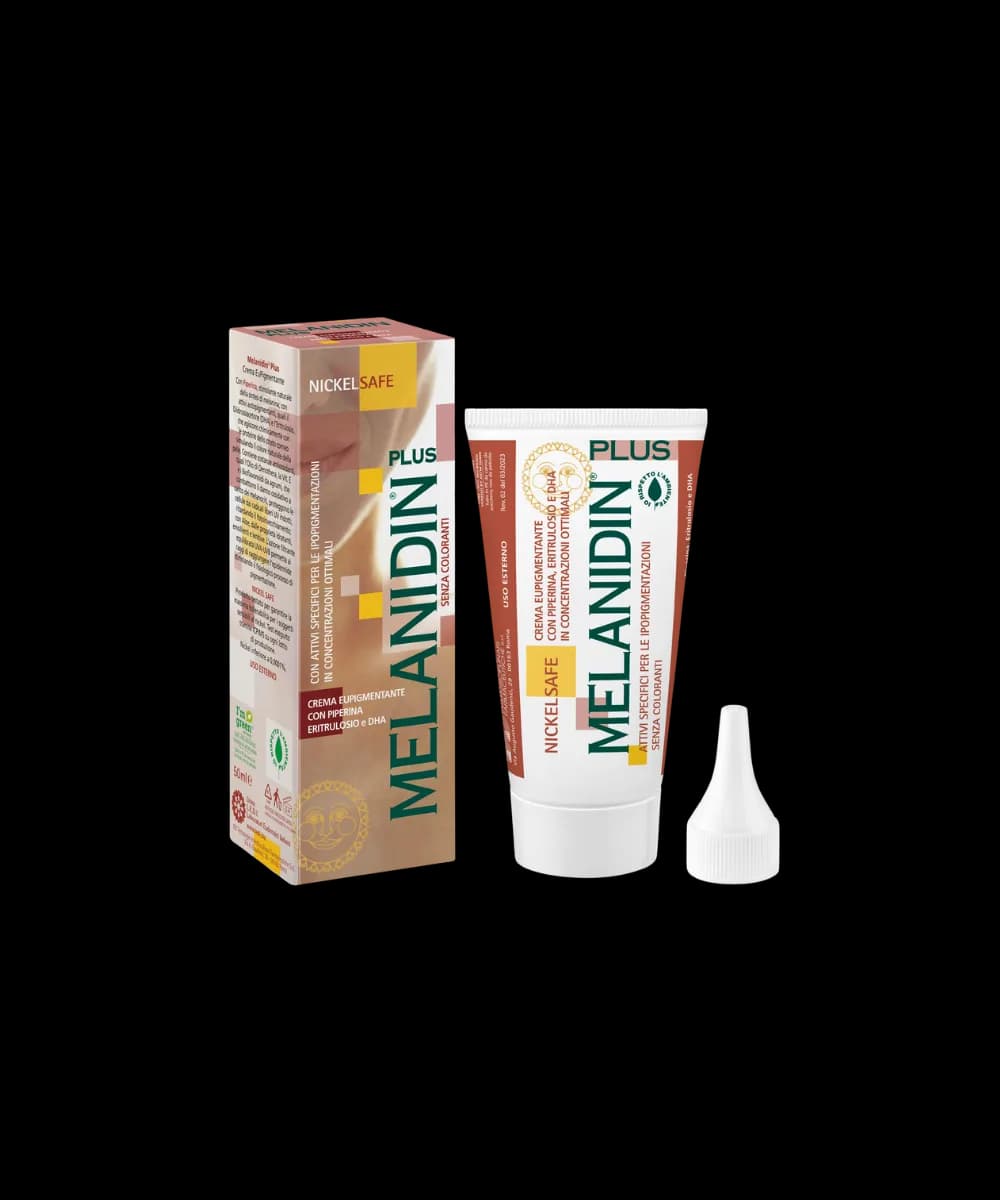
MELANIDIN, on the other hand, is a cream that stimulates the skin's physiological pigmentation process, formulated with actives dedicated to skin colour alterations.
It contains:
- DHA and ERYTHRULOSE, EuPigmenting actives
- PIPERINE, which stimulates melanin production and supports the repigmentation processes of the skin, protecting cells from oxidative stress damage.
Melanidin Plus Cream differs from ordinary self-tanners because it does not simply mask discolouration or pigmentation changes, but stimulates melanin production induced by UV rays, while also promoting proper skin hydration.
In summer, it may also be useful to protect the skin with a specific supplement such as TANNIDIN PLUS chewable and to apply a high-SPF sunscreen during the first weeks of exposure, such as TANNISOL SPF 50+ SUN INTOLERANCE, then switching to a product such as TANNISOL SPF 25 URBAN PROTECTION, in the following weeks.
Please note:
This information is provided for informational purposes only and cannot constitute a diagnosis, the prescription of a treatment, or a substitute for direct contact with a doctor or a specialist visit. Always ask for the advice of your doctor and/or specialists.
For any reports or complaints, please contact the owner of this website at gdtif@gditalia.biz