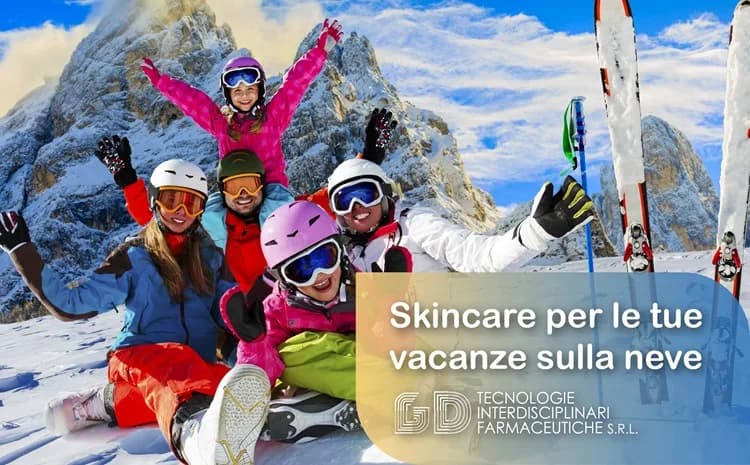
Snow holidays. How to protect your skin on the ski slopes
Snow holidays. How to protect your skin on the ski slopes
The first months of the year, particularly January and February, are the perfect time to plan a snow holiday, especially if you love the mountains and winter sports.
You have surely already got your jacket, gloves, skis and everything you need ready to face the cold and enjoy yourself on the snowy slopes.
But have you also thought about how to take care of your skin while you relax and have fun in the mountains?
The harsh climate and intense exposure to UV rays at high altitude can put your skin's wellbeing to the test, making a targeted skincare routine and adequate sun protection essential.
At the end of this article, you will find some tips on how to protect the skin on your face and keep it healthy even in the most extreme conditions.
Don't underestimate the importance of caring for your skin during snow holidays!
As well as the risk of sunburn, intense cold, wind and dry air can cause irreversible damage.
Winter holidays. Watch out for the sun and intense cold
Imagine a typical day on a snow holiday, perhaps with your family.
In the morning, after a hearty, warming breakfast, you get ready for a day on the slopes. The clear blue sky, the snowy peaks sparkling in the sun, the crisp air…
You put on your ski boots, savouring the fresh air that caresses your face.
The children are thrilled to be putting on skis for the first time.
Between runs, you stop for a break at the mountain hut, with a hot chocolate in hand and a picture-postcard view opening up in front of you.
Everything is so perfect…
But your skin may not see it the same way.
The weather conditions you are exposing it to can put it to the test.
How?
Look up for a moment. The sun is shining high in the sky, reflecting off the bright, sparkling snow.
The biting cold you feel through your ski suit might make you think your skin is safe from the sun's rays.
After all, the harsh climate seems to offer natural protection.
But the reality is different.
When you are in the mountains, the intensity of UV rays is much stronger than when you are in the city, increasing by about 10-12% for every 1,000 metres of altitude.
This means that, even if the air is cool and the sun seems less aggressive, your skin is still exposed to a very high amount of ultraviolet radiation.
Then we have to consider the “mirror” effect produced by the snow.
That white, sparkling blanket not only reflects but amplifies UV rays, bouncing them back onto the skin with an intensity that can be up to 80% greater.
Even the weakest sun or a hazy sky is no excuse to let your guard down: invisible damage builds up, increasing the risk of sunburn, sun spots and premature ageing.
So, if we do not protect ourselves properly, we risk coming home with sunburn, thinking it was just the cold day that made our face red.
The cold, in fact, slightly numbs the skin, masking the first signs of overexposure, such as redness or a feeling of heat.
It is only in the evening, when we look in the mirror, that we realise the damage done to our skin, which burns, reddens and feels tight.
The cold, of course, is not to be underestimated either when we head off to the high mountains.
Low temperatures cause the surface blood vessels to narrow (vasoconstriction), slowing down the skin's microcirculation and reducing the supply of oxygen and nutrients to the tissues.
The skin, deprived of this vital support, becomes more fragile, dry and dull, and its function is impaired.
Mechanisms such as skin regeneration slow down, reducing the skin's ability to repair damage caused by other environmental factors, such as the biting wind or the invisible attack of UV rays.
The cold also alters the skin's hydrolipidic film, that thin protective barrier made up of water and lipids that serves to maintain hydration and protect the skin from external agents.
When its balance is lost, the skin loses further moisture, becoming more vulnerable to irritation, chapping and redness.
Winter skincare. The right products for your ski week
For these reasons, when you get ready to spend a day in the snow, you should not forget to pack the essential products to protect and nourish your skin.
Your skincare routine for winter holidays in the mountains should start with a gentle cleanser, ideal for removing impurities from the skin without altering its hydrolipidic film.
It is best to choose one based on soothing ingredients that do not dry out the skin, already stressed by sun, cold and wind.
The most suitable GD product is Rebioger Aqua Dermopurificante essenziale, with chamomile and bitter orange blossom extract, particularly suitable for cleansing sensitive, delicate, easily irritated skin.
Then use a rich face cream to help you restore and maintain proper hydration, protecting the skin from the effects of the cold.
Among our products, you can try Cutil Crema idratante, enriched with Jaluramina, a concentrate of deep hydration.
This day cream helps to maintain the elasticity of the skin of the face, neck and décolleté, counteracting dryness and dehydration caused by low temperatures and other environmental agents such as temperature swings, wind and sun.
Remember too that, even if the sky is hazy, you cannot do without good sun protection.
TANNISOL CREMA SPF 50+ SUN INTOLERANCE is the very high protection factor cream to always keep with you during your ski week.
Its formulation is the result of months of research and study, which led to the creation of the DNA REACTIVATOR COMPLEX®, an advanced system of protection, prevention and repair that can protect and repair skin DNA damaged by the action of the sun's rays, while at the same time providing an antioxidant action that counteracts the effect of free radicals, which are responsible for premature skin ageing.
TANNISOL SPF 50+ ensures total coverage against UVA, UVB, infrared rays and blue light, defending the skin not only from the sun's rays but also from environmental agents and oxidative stress, thus counteracting the appearance of wrinkles, dark spots (hyperpigmentation) and loss of skin elasticity, keeping the skin young for longer.
Please note:
Information provided for informational purposes only, which cannot constitute a diagnosis, the prescription of a treatment, or a substitute for a direct relationship with a doctor or a specialist visit. Always seek the advice of your own doctor and/or specialists.
For any reports or complaints, please contact the owner of this website at the email address gdtif@gditalia.biz