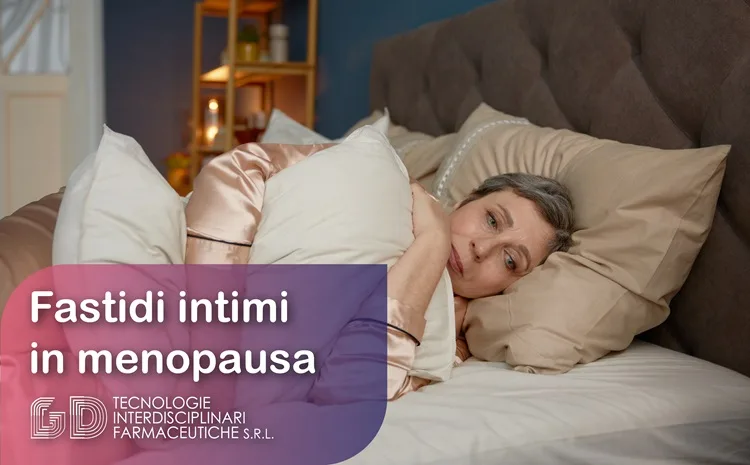
Intimate dryness in menopause and painful intercourse: causes and remedies
Intimate dryness in menopause and painful intercourse: causes and remedies
A woman’s life is a journey of growth and continuous adaptation. It begins with puberty, when the female body starts to change and the arrival of the first period signals the start of the fertile years.
Hormones such as oestrogen and progesterone regulate this phase of life, influencing not only the menstrual cycle but also our physical and emotional balance.
Problems such as mastodynia (breast pain) or headache (menstrual migraine) stem precisely from these hormones, or rather from the continual fluctuations they undergo throughout our adult life.
Then menopause arrives and hormone levels fall sharply. Unfortunately, the discomforts that characterised the fertile years are replaced by new challenges such as vaginal dryness and pain during intercourse.
These symptoms are linked to the decrease in oestrogen, which plays a crucial role in maintaining the lubrication and elasticity of the vaginal tissues.
While it is true that we cannot turn back the clock and go back to being exactly as we were before, it is important to remember that there are solutions.
Facing the changes of menopause consciously makes it possible to rediscover serenity and well-being, in this phase of life too.
Causes of intimate dryness in menopause
Intimate dryness is a problem that many women (not only those entering menopause) find themselves facing.
For some, this disorder begins as early as perimenopause, when the menstrual cycle becomes irregular because of hormonal “whims”.
But that is not all.
New mothers also often experience this discomfort in the period after childbirth and in the following months, while breastfeeding.
Why does all this happen?
Because in menopause, as in the other situations we have mentioned, a woman’s body experiences an oestrogen deficiency.
These hormones not only regulate fertility, but also keep the vagina healthy.
Oestrogens perform a series of fundamental functions for the female reproductive system:
- they promote blood flow to the vagina, ensuring that the tissues receive the right supply of nourishment and oxygen, thus maintaining elasticity and tone;
- they stimulate collagen production, a protein needed to maintain the tone and elasticity of all tissues, including those of the vagina;
- they regulate vaginal pH, preserving the vaginal microbiota. By maintaining a certain degree of acidity, the proliferation of potentially pathogenic bacteria that could trigger infections (such as vaginitis) is hindered, while the growth of “good” bacteria is encouraged.
As a woman approaches menopause, oestrogen gradually declines because the ovaries stop producing it.
It is this absence of oestrogen and other sex steroids, which the female body stops producing, that causes so-called vulvovaginal atrophy, recently renamed “genitourinary syndrome of menopause”.
Oestrogen deficiency causes thinning of the vaginal epithelium, a decrease in natural lubrication and a reduction in vaginal pH.
A condition that shows up as intimate dryness, a disorder as common as it is debilitating, because the discomfort felt interferes with a woman’s daily life, her quality of life and her personal relationships.
Symptoms of vaginal dryness and their impact on the daily life of women in menopause
The main symptoms associated with vaginal dryness in menopause are:
- a constant feeling of dryness: the lack of natural lubrication of the tissues causes a strong sense of discomfort;
- irritation: intimate dryness goes hand in hand with thinning of the vaginal mucosa, which also becomes more fragile and delicate, and easily irritated;
- itching and burning: without adequate hydration, the skin and mucous membranes of the vagina become more vulnerable, increasing the risk of infection or inflammation;
- pain or burning when urinating (dysuria);
- involuntary leakage of urine, especially during physical exertion (e.g. when lifting or moving something heavy)
- needing to wake up in the middle of the night to go to the toilet because of more frequent urination (nocturia)
- recurrent urinary tract infections due to changes in the vaginal bacterial flora and the reduced defensive capacity of the urethral mucosa
- pain during intercourse caused by lack of lubrication;
- prolapse
The impact of these symptoms on daily life is not immediately obvious to those who have not experienced them. But suffering from vaginal dryness in menopause can mean:
- having difficulty walking or sitting for long periods because of intimate burning;
- having difficulty concentrating on work because of constant physical discomfort;
- feeling more anxious, depressed and experiencing a strong sense of inadequacy;
- drifting away from your partner and avoiding intimacy because pain makes it impossible to have intercourse that is satisfying for both;
- having to deal with recurrent infections and irritation such as candidiasis and vaginitis, with further troublesome symptoms and repeated medical treatment
On a psychological level, vaginal dryness can also deeply undermine a woman’s self-esteem.
Feeling distant from your own body and feeling embarrassed or uncomfortable about something that once seemed natural can give rise to a sense of loss or inadequacy, which undermines quality of life and emotional serenity.
It is important to recognise symptoms and signs and address them with the right support, in order to regain balance and improve your well-being.
Treating intimate dryness in menopause
It is possible to treat intimate dryness in menopause and get back to living serenely.
Unfortunately, however, many women are reluctant to seek qualified support from a doctor to establish the causes of their discomfort, obtain a diagnosis and then receive an effective treatment proposal to restore a state of balance.
Why does this happen?
One of the main problems is the embarrassment of talking about such a delicate subject, one that involves the most intimate sphere and is often considered a real taboo.
Social stigma, however, is not the only obstacle.
Some women who suffer from intimate dryness do not recognise its symptoms, or rather think that those discomforts are completely normal at their age and that it is not worth seeing a professional.
In short, there is a tendency to play down the problem without finding out more, thus closing off the possibility of discovering the various treatment options available for intimate dryness in menopause and painful intercourse.
In other cases, the sense of helplessness and frustration is so strong that women come to think that nothing can be done to improve the situation.
But that is not the case at all.
After an examination and an assessment of the reported symptoms, the gynaecologist can prescribe various therapies that can help restore intimate comfort and well-being:
- Vaginal lubricants: water- or silicone-based lubricants can be used during sexual intercourse to relieve pain and ease discomfort.
- Vaginal moisturisers: regular application of vaginal moisturisers helps keep the tissues hydrated, offering long-term relief.
- Hormone replacement therapy (HRT): for women experiencing significant vaginal dryness, HRT can be an effective option. It provides oestrogen in the form of tablets, patches or vaginal rings, helping to restore hormone levels and improve the lubrication and elasticity of the vaginal tissues.
- Vaginal hyaluronic acid: hyaluronic acid can counteract the natural ageing process of the tissues, rehydrating the vaginal mucosa and helping to restore its elasticity.
The hyaluronic acid treatment is minimally invasive and free from contraindications or side effects. Women in menopause who cannot or do not wish to undergo hormone replacement therapy can consider this treatment option for vaginal atrophy and for overcoming painful intercourse, preferring it to moisturisers and lubricants for its greater effectiveness in the short and long term.
In the section of the website dedicated to women’s intimate health and well-being you will find some hyaluronic acid-based products specifically formulated for this kind of need, - Pelvic floor exercises: practising exercises such as Kegels can improve the tone of the pelvic muscles and contribute to better blood circulation in the genital area, thus promoting vaginal health.
- Other therapies: vaginal dehydroepiandrosterone (DHEA), vaginal laser therapy, vaginal radiofrequency therapy and oxygen therapy
Warning:
Information provided for informational purposes only, which cannot constitute a diagnosis, the prescription of a treatment, or a substitute for direct consultation with a doctor or a specialist visit. Always ask for the advice of your doctor and/or specialists.
For any reports or complaints, please contact the owner of this website at the email address gdtif@gditalia.biz