White spots on the skin: what are they and what can you do?
There are various types of white spots that appear on the skin, especially in summer. Let's find out together how to deal with them
In summer, because of excessive sun exposure and other factors, patches may appear on the skin. Sometimes these are dark spots, due to increased melanin production. In other cases, however, they are white spots, much lighter than the normal tone of our skin.
To use a technical term, we speak of hypochromia or hypopigmentation.
White spots on the skin can usually be traced back to four different causes:
- vitiligo
- fungal infections such as pityriasis versicolor
- idiopathic guttate hypomelanosis
- skin trauma (post-traumatic hypopigmentation)
- lesions due to inflammation (post-inflammatory hypopigmentation)
Vitiligo: a chronic skin condition
Vitiligo is a chronic skin condition that shows up as white spots on the skin in different areas of the body. It is caused by an alteration of the melanocytes, the cells responsible for producing melanin, the substance that gives colour to hair and skin.
There are two variants of vitiligo:
- bilateral or symmetrical vitiligo
- segmental vitiligo
In bilateral vitiligo, areas of the body are affected in a mirror-image pattern. This means the spots are arranged symmetrically on the right and left sides. Bilateral or symmetrical vitiligo is the most common variant.
Then there is segmental vitiligo, which is less common and appears as light patches that affect only one half of the body and are arranged as if forming a sort of track
The reason for this disorder is not yet clear.
The most widely accepted hypothesis is that it is an autoimmune disease. As some recent studies show, people with vitiligo often also suffer from other diseases of this type, such as alopecia areata and thyroid disorders.
Genetic predisposition and family history probably also play a role in the onset of vitiligo. Other factors, such as severe stress and weakened immune defences, can aggravate the disorder.
It affects men and women of any ethnicity without distinction. In people with darker skin, the white spots are very noticeable. In those with fairer skin, on the other hand, the discolouration is more noticeable in summer, because tanned skin contrasts more with the lighter patches.
Vitiligo usually appears before adolescence, and in any case by the age of 20, so at a young age. In people who develop the condition in childhood, the spots usually cover less than 10% of the body surface.
It is not a contagious or dangerous condition.
Vitiligo has no particular consequences for a person's physical health. However, people with this skin condition often face heavy psychological consequences, developing disorders such as social anxiety and depression. Dealing with other people's gaze and opinions, unfortunately, is not at all easy. Nor is it easy to accept seeing your own body change and transform.
Pityriasis versicolor: all the fault of a skin fungus
While the exact causes of vitiligo are still unknown, pityriasis versicolor (or tinea versicolor) has a precise culprit: Pityrosporum orbiculare or Malassezia furfur. It is a fungus that lives on our skin and scalp without causing us any trouble, feeding on the sebum produced by our glands. Because of this characteristic it is described as a “saprophytic commensal”.
It is part of the so-called skin flora or skin microbiota, together with dozens of other microorganisms.
The fungus proliferates and becomes aggressive, attacking the skin, under certain particular conditions:
- hot, humid weather, ideal for the spread of microorganisms of this type
- spending time in humid environments such as gyms and swimming pools
- excessive sweating
- oily skin
- a weakened immune system (immunodepression)
- taking certain medicines such as corticosteroids, immunosuppressants and oral contraceptives
- malnutrition
Infection by Malassezia furfur interferes with the normal production of melanin and the resulting pigmentation of the skin. The result is the appearance of small, lighter-coloured spots on the skin, generally on the upper body, on the back, chest, neck and arms.
Other typical symptoms of pityriasis versicolor are:
- mild itching
- flaking of the skin, similar to dandruff
The condition pityriasis versicolor is wrongly called sea fungus.
Let's dispel a myth, a false belief: going to the beach, sunbathing and swimming do not make the disorder worse. Simply, with a tan, the small skin discolourations become more visible. They catch the eye.
The sea neither promotes nor causes the mycosis, which is caused by other conditions that encourage the growth of this fungus already naturally present on our skin.
Idiopathic guttate hypomelanosis
What is idiopathic guttate hypomelanosis?
This scientific name, which may leave many people baffled, refers to a skin pigmentation disorder resulting from chronic damage to the melanocytes, due to prolonged and excessive sun exposure.
We often don't think about it, but the sun is not always an ally of our health. It's true that it is good for us, that it lifts our mood, that it helps us synthesise vitamin D… However, getting too much of it without the proper precautions means putting our skin under strain and speeding up its natural ageing process.
Usually, idiopathic guttate hypomelanosis affects people who are already a little older, especially after the age of 50/60.
The small white spots are round and very small, like small drops or tiny pieces of confetti that appear mainly on the skin of the hands, arms, legs and face, that is, on the areas most often touched by solar radiation.
It is an entirely benign and non-contagious skin imperfection.
White spots on the skin after trauma: post-traumatic hypopigmentation
White spots appearing on the skin can also be the result of trauma to the skin. This may be an accident, the unexpected outcome of a treatment, for example an abrasive treatment, laser hair removal or an overly aggressive and deep chemical peel, but also the effect of surgery.
In all these cases, the skin suffers damage that repairs itself spontaneously over time. Often, however, a scar forms, whose colour looks lighter than the natural colour of our skin.
This is post-traumatic hypopigmentation.
White spots on the skin due to inflammation: post-inflammatory hypopigmentation
The sudden appearance of light skin patches could also be the direct consequence of certain inflammatory conditions such as bullous dermatosis or other types of skin infection that often leave scars behind.
The causes of post-inflammatory hypopigmentation also include acne.
Some remedies for light skin patches
Before treating any discolouration, whether a dark or a light spot, you should first of all consult your dermatologist. Only an expert can carefully assess the spot, make a diagnosis and prescribe any therapy.
Here, we will limit ourselves to giving a few suggestions.
How to treat vitiligo
For vitiligo, there are several therapies aimed at restoring the original appearance of the skin as far as possible and preventing the condition from progressing:
- UVB phototherapy
- drug therapy
Narrowband UVB phototherapy consists of exposure to high-concentration ultraviolet rays emitted by special, purpose-built machines. Only the areas of the body affected by vitiligo are treated. This avoids creating greater colour contrast between healthy skin and skin dotted with white patches.
The radiation hits the melanocytes at the edges of the spots or in the hair follicles and stimulates their proliferation.
The repigmentation process through phototherapy can be supported by taking Pigmadin, a 100% vegan supplement with a eupigmenting and immunomodulating action.
Pigmadin's formulation, based on powerful antioxidants, makes it particularly suitable and effective for supporting phototherapy. This supplement is in fact able to improve the skin's response to treatment, amplifying its benefits.
Taking Pigmadin makes it possible to increase the skin's tolerance to UV rays and consequently to undergo longer phototherapy sessions, with better results over time.
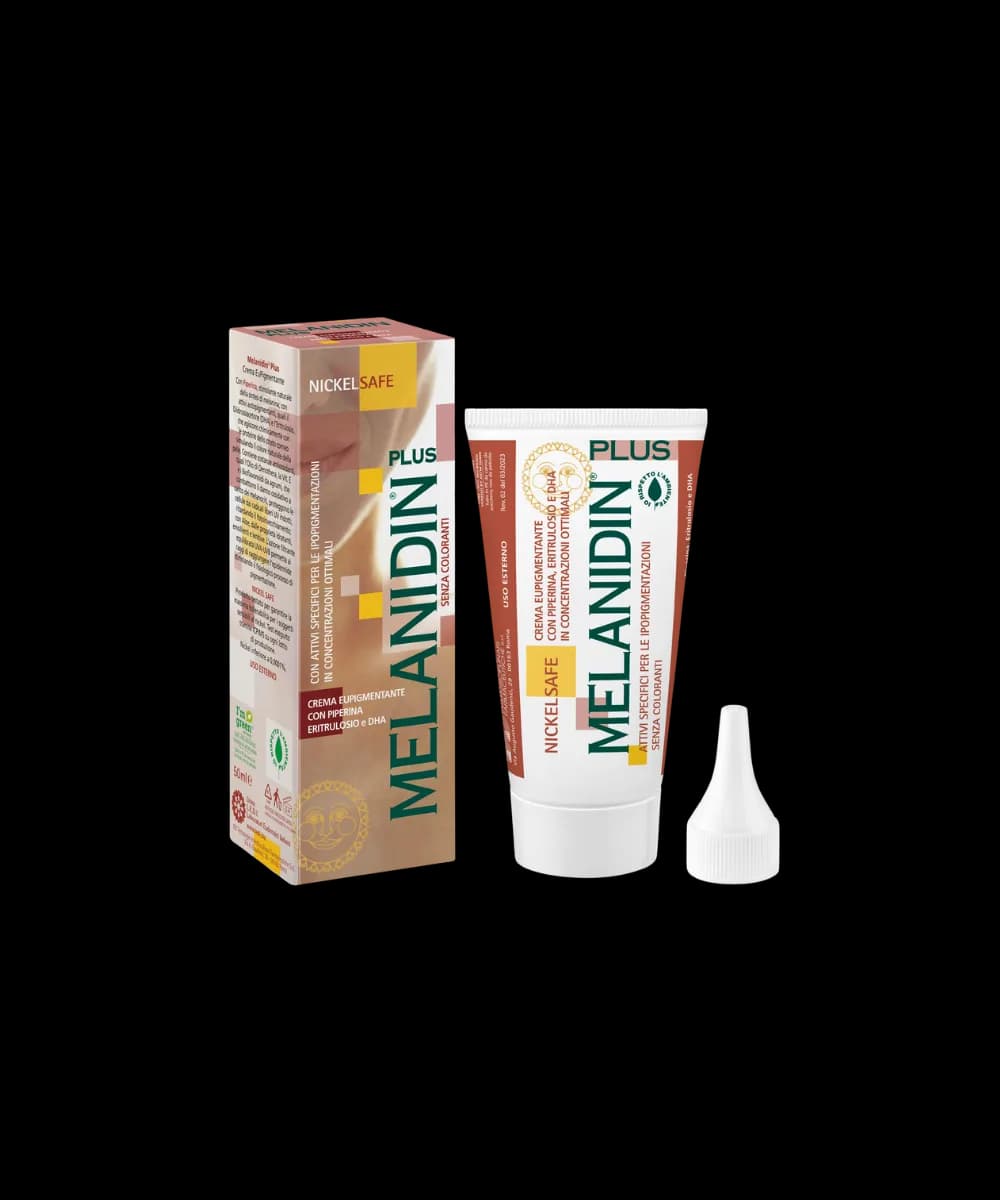
The use of Pigmadin can be combined with Melanidin. A cream that does not simply cover the lighter spots, but acts directly on them:
- stimulates melanin synthesis
- fights damage caused by free radicals
- keeps the skin hydrated
- protects the skin from photodamage
Drug therapy for the treatment of vitiligo, on the other hand, involves the use of cortisone-based creams (corticosteroids) applied to the patches. In some cases immunosuppressants are also prescribed.
How to treat pityriasis versicolor
The treatment of pityriasis versicolor may involve different techniques and products depending on various factors such as the extent and location of the spot, its thickness and the time of year.
A first step is daily cleansing of the skin affected by tinea versicolor with a medicated cleanser or shampoo with an acidic pH. The product should be left on for 5/10 minutes before rinsing with water. Cleansing must be carried out regularly.
The dermatologist may also prescribe antifungal medicines.
If the light skin patches are small and very localised, you can opt for creams, ointments or mousses to apply directly to the skin. The active ingredients usually found in the formulation of these products are: ketoconazole, ciclopirox, clotrimazole, miconazole, terbinafine…
Where very large areas of skin need to be treated (for example the back) or when pityriasis versicolor tends to come back after treatment, the dermatologist may suggest taking oral medicines formulated to counteract fungal infections of this type.
At the same time, you can also use Melanidin, a product that is useful not only cosmetically but also practically. Melanidin in fact gradually corrects the skin imperfection, giving an even complexion very similar to your natural one.
Fortunately, pityriasis versicolor is not contagious. As a result, there is no need to isolate yourself or avoid contact with others, nor to sterilise the clothes you normally wear.
How to treat idiopathic guttate hypomelanosis
At present, there is no definitive, specific therapy to eliminate the spots caused by idiopathic guttate hypomelanosis. Erasing them completely is impossible.
There are, however, some treatment strategies that can achieve satisfactory results.
We can use cryotherapy, a very common method in dermatology, which involves applying liquid nitrogen directly to the skin lesion, causing a cold burn.
Others suggest the use of dermabrasion or the application of topical steroids.
To limit the cosmetic damage, we also suggest using Melanidin.
How to treat post-traumatic and post-inflammatory hypochromia
In the case of discolouration due to inflammation or trauma, we suggest taking Pigmadin, a food supplement made by GD.
For any reports or complaints, please contact the owner of this website at the email address gdtif@gditalia.biz