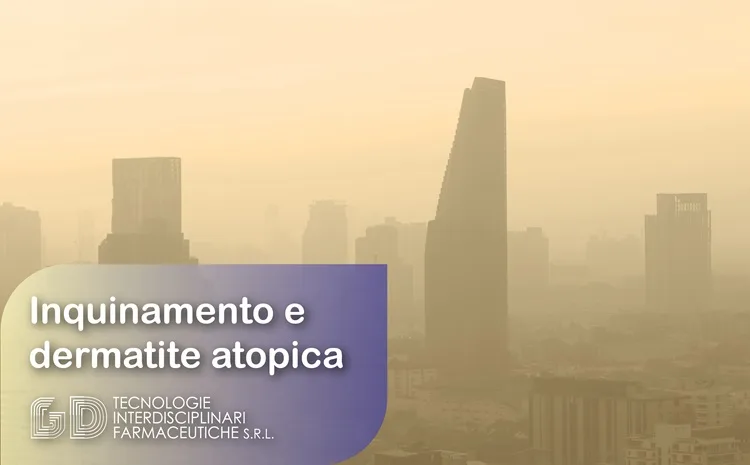
Pollution and atopic dermatitis. How smog harms skin health
Pollution and atopic dermatitis. How smog harms skin health
The skin disease atopic dermatitis can be triggered, among other things, by various factors such as pollen, animal hair and other allergenic substances, which can set off an inflammatory reaction in the skin, which becomes dry, itchy, irritated and red.
But atopic-prone skin is also affected by exposure to pollution, which can trigger or worsen the symptoms of the condition.
Unfortunately, we live surrounded by smog, which reaches very high concentrations in big cities. Every day we breathe air laden with particulate matter, heavy metals and toxic gases, which damage not only the lungs but the whole body, starting with the skin.
But how can pollution lead to the development of atopic dermatitis?
And what strategies can be adopted to prevent the damage?
Pollution and atopic dermatitis: how smog compromises the skin barrier
One of the main features of atopic dermatitis is extreme skin dryness, which gives rise to a feeling of discomfort, tightness and itching.
This dryness is the sign of an alteration of the skin barrier, the skin's natural protection against external agents.
When the skin barrier is compromised:
- it cannot retain water properly, which is lost, preventing the skin from maintaining a correct level of hydration;
- it cannot perform its protective function, so external agents penetrate more easily, aggravating the inflammation.
What does all this have to do with smog?
Well, the substances in polluted air act precisely on the skin barrier, compromising its integrity and function in various ways.
Let us see how.
Effects of particulate matter on the skin
Particulate matter (PM10 and PM2.5) is made up of tiny solid and liquid particles suspended in the air, so fine that when they settle on the skin they manage to work their way into the deepest layers.
These substances can cause the formation of free radicals, highly reactive and unstable molecules that are at the root of so-called oxidative stress.
Normally, the skin is able to react by activating its natural defence, represented by antioxidants, substances able to counter the negative effects of the oxidative process.
However, when exposure to these factors is excessive or prolonged (as in the case of people who live and work in cities), the level of free radicals exceeds the skin's ability to neutralise them, causing cellular and structural damage.
The ones that pay the price are the cells of the skin barrier, which is weakened and made more permeable to external allergens and irritants.
This predisposes the skin to the onset of atopic dermatitis or, if you already suffer from this skin condition, can worsen its symptoms.
Particulate matter also contains heavy metals, polycyclic aromatic hydrocarbons (PAHs) and other toxic chemicals, which amplify the inflammation.
Effects of nitrogen oxide on the skin
Nitrogen oxides, gaseous pollutants that are very common in urban areas because they are produced by car exhaust and during industrial processes, have inflammatory and immunomodulating effects on the skin.
These substances, in fact, interact with the immune system and are able to activate an inflammatory response, aggravating or predisposing to chronic conditions such as atopic dermatitis.
In combination with other pollutants, nitrogen oxide stimulates the production of free radicals and increases oxidative stress, damaging skin cells and weakening the skin's ability to repair itself.
Effects of dust and heavy metals
Dust containing heavy metals, such as lead and mercury, also has similar effects, contributing to oxidative damage.
The result is a weakening of the skin barrier, which can lead to allergic reactions or to the worsening of pre-existing inflammatory conditions, such as atopic dermatitis.
Effects of pollution on the skin microbiota
The skin microbiota, the community of beneficial microorganisms that live on the surface of the skin and help maintain its balance and health, is also affected by exposure to smog.
Air pollutants such as heavy metals and particulate matter can:
- alter the composition of the skin's bacterial flora (skin dysbiosis), reducing its diversity and encouraging the proliferation of harmful microorganisms, which can gain the upper hand over beneficial ones;
- interfere with the activity of the bacteria themselves which are damaged by oxidative stress and can no longer protect the skin effectively from infections
Countering the effects of pollution on atopic skin
For those who suffer from atopic dermatitis, protecting the skin from the harmful effects of smog is essential.
Adopting some simple preventive strategies and using specific products to improve the resistance of the skin barrier can be a great help in countering the impact of pollution on the skin, strengthening its defences and reducing inflammation and therefore the symptoms of atopic dermatitis such as dryness, irritation and itching.
Defend your skin from smog with Cleansing
Cleansing is a simple but by no means trivial gesture which, when repeated consistently over time, has an extremely beneficial effect on chronically irritated skin.
Through cleansing, in fact, we remove the smog particles that have accumulated on the skin during the day, preventing them from penetrating and building up in the deeper layers during the night's rest.
The most suitable cleanser for these situations is a product based on moisturising and soothing ingredients such as AVEC DETERGENTE MOUSSE, specifically formulated to gently care for dry, sensitive and easily irritated skin
Thanks to its specific formulation, Avec Detergente Mousse ensures deep cleansing, provides precious nourishment to the skin, moisturises it and helps restore the protective barrier, supporting the natural regenerative capacity of the epidermis.
Strengthen the skin barrier with Hydration
The first symptom of an altered skin barrier is dehydration which shows itself as dryness.
In the case of atopic dermatitis, therefore, it is essential to restore and maintain proper hydration with a product such as AVEC CREMA soothing and moisturising, formulated for dry and fragile skin suffering from chronic irritation, dermatitis and other skin reactivity disorders.
Its specific active ingredients, as well as soothing irritation and bringing relief, improve skin trophism, reduce sensitivity to irritants and give altered skin back its hydration.
Use a sunscreen against free radical attack
Another effective measure against the damage caused by air pollution is the use of a sun protection containing antioxidant active ingredients, to be applied every day.
There are, in fact, products containing filters that are able not only to screen out UV rays, which are responsible for degeneration of skin DNA and premature ageing, but also to defend us from environmental aggressions and in particular from the free radicals caused by smog.
Consider, for example, TANNISOL CREMA SPF 25 URBAN PROTECTION, a year-round photoprotection product that ensures 24-hour coverage against oxidative stress thanks to Vitamin E, a powerful antioxidant, in its formulation.
TANNISOL CREMA SPF 25 defends the skin, especially the delicate and sensitive skin of those with atopic dermatitis, from the harmful effects of UV rays and environmental pollution, without interfering with the absorption of vitamin D, which is precious for our body.
Its extraordinary effectiveness, proven by numerous laboratory tests, is due to DNA REACTIVATOR COMPLEX®, a latest-generation complex obtained by combining powerful active ingredients such as Phytoplankton extract and Polygonum aviculare extract with other selected broad-spectrum filters.
Supplement for atopic dermatitis
The use of supplements can help improve skin health from within through the intake of nutrients that help to reduce inflammation and strengthen the skin barrier, thus making it possible to manage atopic dermatitis caused by smog or other environmental factors.
Until now, the classic systemic therapy for atopic skin involved taking live lactic ferments in order to rebalance the gut microbiota.
Our approach looks further.
Avec® Integratore, with its multiple mechanisms of action, offers valuable support for all the needs of atopic-prone skin, working on several fronts to promote the overall well-being of the person.
AVEC is a food supplement formulated with plant-based active ingredients, vitamins and minerals such as:
• Ceramosides from Triticum aestivum
• Hyaluronic acid 50kDa (low molecular weight)
• Viola tricolor which helps improve the body's purifying functions and skin well-being
• Perilla and Ashwagandha, which improve the body's natural defences
In addition, Ashwagandha promotes relaxation and mental well-being
• Vitamin A, Biotin and Zinc contribute to the maintenance of healthy skin
• Vitamin D, Copper, Vitamin A and Zinc contribute to the improvement of the normal functions of the immune system
In addition, Copper contributes to the maintenance of normal connective tissues
Please note:
Information provided for informational purposes only, which cannot constitute a diagnosis, the prescription of a treatment, or a substitute for direct contact with a doctor or a specialist visit. You are always advised to seek the opinion of your own doctor and/or specialists.
For any reports or complaints, please contact the owner of this website at the email address gdtif@gditalia.biz