Coenzyme Q10, an elixir of beauty and health
Coenzyme Q10 is a true elixir of health and beauty, with extraordinary properties that benefit the wellbeing of the whole body. Discover them
Coenzyme Q10: what is it and what is it for?
You will have heard about Coenzyme Q10 and its extraordinary health benefits a thousand times in adverts.
But what is it and, above all, what is it for?
Coenzyme Q10, better known as ubiquinone, is a molecule produced naturally by our body. Usually, there is no need to obtain it through diet. In particular, it is found inside the mitochondria, small organelles found in cells that are often called the "power stations of the cell".
Coenzyme Q10 is used by our cells to produce energy.
Ubiquinone is essential for the perfect machine that is the human body to work properly. Without it, many organs could not carry out their activities.
As we get older and reach maturity, the amount of ubiquinone in our body decreases. Unfortunately, a Coenzyme Q10 deficiency is often associated with degenerative states and chronic diseases, including serious and debilitating ones:
- heart failure,
- myocardial infarction
- migraine
- chronic kidney disease
- hypertension
- Alzheimer's
- Parkinson's
What makes Coenzyme Q10 an extremely beneficial substance is its extraordinary power as a natural antioxidant, able to neutralise the harmful effects of free radicals. It is no coincidence that it is considered a great ally for the health of our body.
Main benefits of Coenzyme Q10
What are the main benefits of taking Coenzyme Q10?
Here they are in brief.
It maintains energy levels
One of the main functions of ubiquinone is to support the right energy levels. It counteracts chronic fatigue, helping to give the muscles (including the heart and the brain) the resources they need to do their job well.
According to some studies, ubiquinone can also protect us from muscle damage resulting from overly intense physical activity. It is therefore particularly suitable for people who play sport, but also for those who have to take statins and beta blockers, whose side effects include muscle pain and tiredness, and for older people.
It counteracts oxidative stress
As mentioned above, Coenzyme Q10 is an excellent antioxidant, highly effective against the damage caused by free radical attack. This means that ubiquinone is a sort of elixir of long life, useful and effective in the prevention of ageing and its consequences, including at a functional level.
When we hear about ageing, we often think only of appearance, of the signs of age that appear on the face and body, overlooking other, much less visible effects of senescence. The oxidative stress that accompanies advancing age has harmful effects on the heart, the blood vessels, the brain and so on.
Coenzyme Q10 does not stop time passing. But it is a tool for ageing well and healthily, protecting yourself from diseases and dysfunctions.
It helps the heart and lowers blood pressure
Coenzyme Q10 is a true cardioprotective agent, able to keep our heart healthy and working perfectly, providing it with the resources it needs to beat with the right energy. It can hinder the oxidation of LDL cholesterol particles (bad cholesterol), protecting the heart muscle against diseases such as arteriosclerosis, heart attack and stroke.
It also regulates blood pressure, helping to keep it at suitable levels.
Coenzyme Q10 and the skin: skin ageing, psoriasis and other skin conditions
Coenzyme Q10 is also good for the skin, in several ways.
It is a natural anti-ageing agent, able to slow down skin ageing. It stimulates the production of collagen and elastin. In this way it reduces the loss of skin elasticity, counteracting the formation of wrinkles and other blemishes that come with the passing of time.
It also protects the skin from external agents such as air pollution and UVA rays, which cause premature skin ageing.
Several clinical studies have also shown that ubiquinone, in combination with other antioxidants, has beneficial effects on inflammatory skin conditions such as psoriasis.
Coenzyme Q10: which foods contain it?
As we have said, Coenzyme Q10 is produced naturally by our body and is present in every cell of our body. However, over time, and also because of certain diseases, deficiencies can develop, which can have very negative consequences for our health.
So we may wonder whether it is possible to supplement this molecule through a specific diet.
The main dietary sources of Coenzyme Q10 are of animal origin. It is found in large quantities:
- in beef, pork and chicken, especially in the heart and liver
- in fish (mackerel, sardines, salmon, trout)
But even those who follow a vegetarian or vegan diet, for health reasons or as an ethical choice linked to the wish to respect nature as much as possible, can include in their diet some foods that contain Coenzyme Q10, such as:
- pistachios and nuts in general
- soya
- sesame seeds
- broccoli
- strawberries
- oranges
- spinach
- peppers
It should be remembered that Coenzyme Q10 is found in fresh foods. Frozen or tinned fruit and vegetables do not contain this molecule. In addition, these foods should always be eaten in their natural state so that they keep their properties intact.
However, diet covers only 25% of our body's ubiquinone requirement.
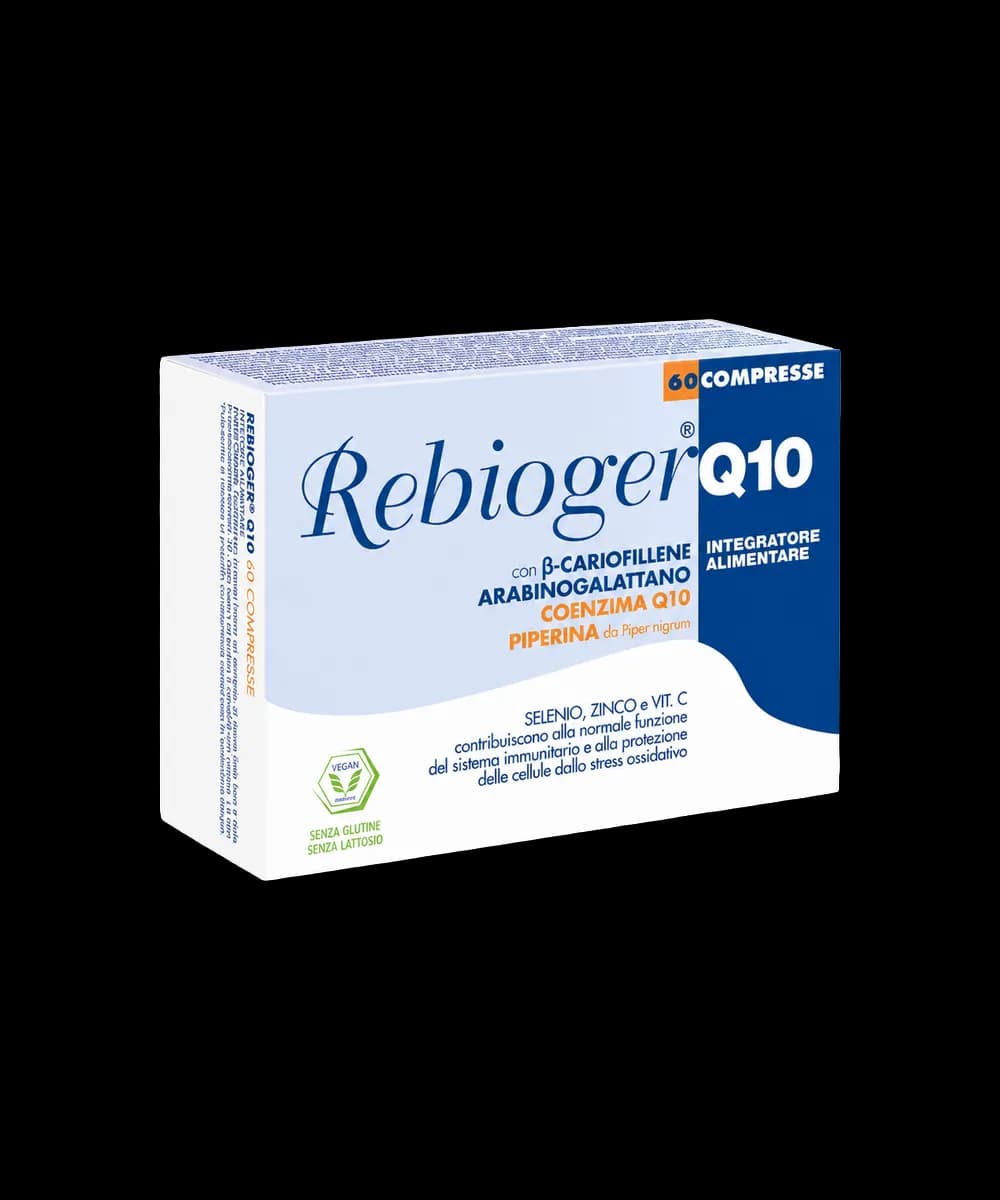
Another option for those who want to take a good amount of ubiquinone without having to eat the animal-based foods that are particularly rich in it is to use a 100% vegan food supplement such as our Rebioger Q10 tablets, gluten-free and lactose-free, also suitable for people with allergies or intolerances.
Our coenzyme Q10 supplement: Rebioger Q10
Rebioger Q10 is our food supplement formulated with plant-based active ingredients, vitamins and minerals such as:
COENZYME Q10 AND HESPERIDIN
β-CARYOPHYLLENE FROM CLOVES AND BLACK PEPPER, ANTIOXIDANTS
ARABINOGALACTAN FROM LARCH EXTRACT
ECHINACEA WHICH SUPPORTS THE BODY'S NATURAL DEFENCES
Ω 6 UNSATURATED FATTY ACIDS FROM BORAGE OIL, WHICH SUPPORT THE INTEGRITY AND FUNCTION OF CELL MEMBRANES AND SKIN TROPHISM
VITAMINS C, B6, D2, SELENIUM AND ZINC WHICH CONTRIBUTE TO THE NORMAL FUNCTION OF THE IMMUNE SYSTEM
VITAMINS C AND E: WHICH CONTRIBUTE TO THE PROTECTION OF CELLS FROM OXIDATIVE STRESS
VITAMIN C ALSO CONTRIBUTES TO NORMAL COLLAGEN FORMATION FOR THE NORMAL FUNCTION OF SKIN AND BONES
BIOTIN AND ZINC: CONTRIBUTE TO THE MAINTENANCE OF NORMAL SKIN AND HAIR
D2: CONTRIBUTES TO THE MAINTENANCE OF NORMAL BONES
Warning
Information provided for informational purposes only, which cannot constitute a diagnosis or the prescription of a treatment, or replace a direct relationship with your doctor or a specialist consultation. You are always advised to seek the opinion of your doctor and/or specialists.
For any reports or complaints, please contact the owner of this website at gdtif@gditalia.biz