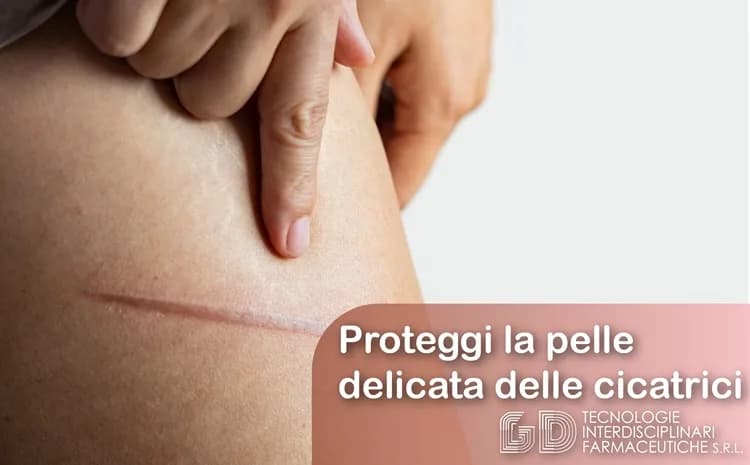
Sun and scars. Here is how to protect your skin
Exposing scars to the sun can prevent them from healing and cause dark spots to appear. Find out how to prevent them
Summer brings with it the promise of long sunny days, spent tanning on the beach, exploring foreign cities and savouring exotic cuisines, or trekking in the mountains in search of breathtaking views and cool air.
If, however, you have recently had surgery or have had an accident that left a scar, that warm sun could be a problem.
Scars, in fact, are particularly sensitive to UV rays. Protecting yourself properly is essential not only to avoid sunburn and skin damage, but also to preserve the even appearance of the skin.
Read on to find out why scars are vulnerable to the sun and what effects the sun's rays have on damaged skin, even on cloudy days; what the different types of scar are and how to prevent them, avoiding the appearance of light or dark marks on your body.
What happens to scars in the sun?
As you already know if you have read our articles on the effects of the sun on the skin, UV rays can penetrate deeply, causing considerable damage to skin DNA and leading to:
- acceleration of skin ageing (photoageing), which shows itself through the appearance of wrinkles, loss of tone and elasticity and a progressive thinning of the dermis
- sun spots
- actinic keratoses or precancerous lesions that can degenerate into genuine skin cancers
- skin melanomas
Where there are scars (due to trauma, surgery, burns, cuts or the after-effects of severe acne), the skin in that area is even more delicate and sensitive, extremely vulnerable to the harmful action of ultraviolet light.
So, what happens to scars in the sun?
One of the main risks is that the scar becomes more noticeable, taking on a dark colour (brown or black).
This is because the healing process goes through inflammation, which can stimulate skin cells to produce more melanin, especially if the skin is exposed to UV rays.
This is what we call post-inflammatory hyperpigmentation.
We must also bear in mind that, in areas where there is a scar, the skin is still working to repair damaged tissue. Scarred skin has a compromised skin barrier, unable to provide the necessary protection against solar radiation.
This is why damaged skin tends to darken in the sun.
But discolouration is not the only side effect of exposing scars to UV rays.
It is also possible for the sun to interfere with the healing process of the lesion, slowing it down or stopping it.
This happens for several reasons, including:
- the cell damage caused by the sun itself: UV rays can directly damage skin cells, including fibroblasts, which are responsible for producing collagen and for tissue regeneration. Damage to fibroblasts prevents new scar tissue from forming, slowing down or stopping the process that leads to complete healing of the wound;
- Inflammation: Exposure to UV rays can increase inflammation in the scarred area. Prolonged inflammation can compromise the normal healing of the skin, leading to more pronounced scars.
Not all scars are the same
Scars can come in various forms, each with distinctive features.
This is why it is always a good idea to consult an experienced dermatologist to find out the best treatment to help them heal.
Regardless of their appearance and what caused them, however, the rule regarding the sun is always the same: never expose yourself without very high protection.
But we will come to that in the next sections.
Below you will find a brief overview of the three main types of scars:
- hypertrophic scars
- keloids
- atrophic scars
Hypertrophic scars
Hypertrophic scars are the result of an excessive production of fibrous tissue during the wound healing process, which makes them grow more than necessary.
While remaining within the boundaries of the original lesion, these scars have a "raised" appearance: they are thick and raised compared with the surrounding skin, and red or purple in the early stages.
They can form following trauma, surgery, burns or even minor wounds that do not heal properly.
Keloids
Keloids also form because of an uncontrolled proliferation of scar tissue, which, however, unlike what happens in hypertrophic scars, extends well beyond the boundaries of the original wound.
The colour varies a great deal, from pink to deep red, dark brown or black, depending on skin tone.
Genetic predisposition plays a significant role in the formation of keloids: people with darker skin are more susceptible to this kind of scarring, which originates from minor skin traumas such as cuts, abrasions, piercings, tattoos, burns and surgery, and also following acne.
Atrophic scars
Atrophic scars are the result of an altered healing process. In some cases, in fact, the skin is unable to regenerate enough tissue to "fill" the area where the lesion opened. As a result, these scars form depressions or hollows.
They are common in conditions such as severe acne and chickenpox, but can also result from surgical lesions or trauma.
How to care for skin with scars
Caring for skin with scars is essential to improve their appearance, promote faster healing and prevent further complications such as hyperpigmentation or inflammation.
One of the most important steps is cleansing, which is needed to reduce skin inflammation and to remove from the wound any traces of dirt, bacteria and impurities that could cause infections.
Of course, it is not advisable to use a simple cleanser or the soap you normally use. You need to choose products free from fragrances and other chemical agents that could irritate already suffering skin.
Among GD products, the choice is ISODERMA, a balanced liquid cleanser without soap, with Aloe and Coconut Oil, which helps the skin regenerate and restore the altered skin barrier. Thanks to its specific formulation, ISODERMA can also be used on the most intimate and delicate areas, after surgery as well as in the days following childbirth, for safe and thorough hygiene.
Hydration is also a fundamental step in caring for scars and minimising them. Our suggestion is to apply EUTRODIN, a soothing and protective cream with an anti-inflammatory action. Rich in nourishing substances such as oils and hydrolysed collagen proteins, Eutrodin Crema contributes to the general well-being of the skin and to the deep hydration of the skin tissue.
But what must never be forgotten when we talk about scars is protection, to be used in every season of the year and not only in summer, when we expose ourselves directly.
We discuss this in more detail in the next section.
Can you sunbathe when you have scars?
Generally speaking, as we pointed out at the beginning, exposing yourself to the sun when your skin has scars is inadvisable, if not forbidden, especially if the scars are recent and still healing.
However, by taking a few precautions it is possible to sunbathe safely, preventing damage to the skin.
Protecting scars from the sun: tips and useful products
Exposing yourself to the sun with scars requires special care, and not only in summer. We must remember, in fact, that solar radiation is present all year round, regardless of the season, of whether the climate is mild or not, or of a cloudy sky.
This means that wherever we are (whether enjoying the sea on a tropical island or shopping in the city on a cold winter's day), we should always take precautions.
And not only when we have scars, but also to keep the skin healthy and young for longer, preventing photoageing.
So, first of all, it is best to limit sun exposure to the cooler times of day, that is, early in the morning or in the evening.
Even if you choose these times, you must never forget to apply a broad-spectrum sun protection with a high SPF to your scars, preferably 50+.
Among GD products we can certainly recommend TANNISOL SPF 50+ SUN INTOLERANCE with DNA REACTIVATOR COMPLEX®, an advanced system for protecting against, preventing and repairing skin damage caused by sun exposure.
TANNISOL CREMA SPF 50+ SUN INTOLERANCE provides full coverage across the entire electromagnetic spectrum, defending the skin not only from the sun's rays but also from environmental agents and oxidative stress, thus countering the appearance of wrinkles, dark spots (hyperpigmentation) and loss of skin elasticity, keeping the skin young for longer.
Please note:
Information provided for informational purposes only, which cannot constitute a diagnosis, the prescription of a treatment, or a substitute for direct contact with a doctor or a specialist visit. You are always advised to seek the opinion of your own doctor and/or specialists.
For any reports or complaints, please contact the owner of this website at the email address gdtif@gditalia.biz