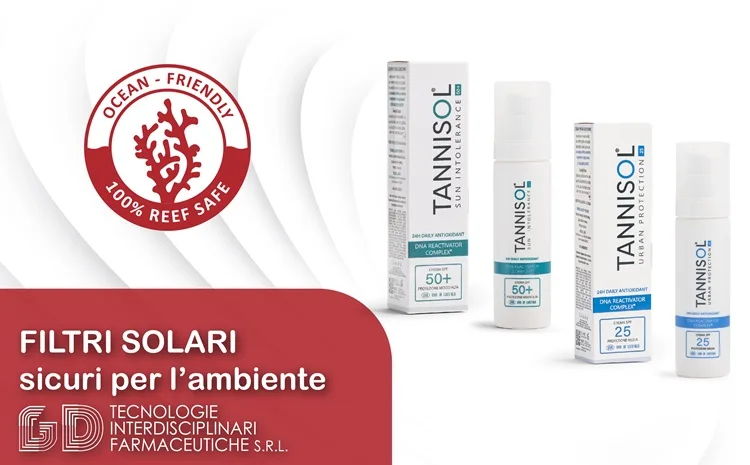
Protecting your skin from the sun without harming the environment
You can protect yourself from the sun and preserve the marine ecosystem thanks to the innovative sun filters in TANNISOL creams
In recent years, people's awareness of environmental problems linked to pollution has grown strongly. There is ever greater awareness of how our choices affect the natural ecosystem, causing imbalances and damage.
GD has always followed a "natural" approach, embracing green solutions both in the formulation of its dermocosmetic products and supplements and in its packaging, choosing materials from ecological and renewable sources.
This makes us feel more in tune with nature, in harmony with the earth, the air and the water.
It was precisely the theme of water and the protection of the marine ecosystem that guided our choices regarding sun filters and sun protection in creating a new range of products launched this year: TANNISOL, with DNA REACTIVATOR COMPLEX®, an innovative screening system that protects against damage from UVA, UVB and infrared rays and blue light, while reactivating the repair processes of damaged skin cell DNA and counteracting the action of free radicals on the skin.
But what is the link between our photoprotection products and the protection of the marine environment?
A deep and important link for those who put nature first.
Sun protection and sea pollution: how the filters that protect us from the sun destroy coral reefs
Constant, careful use of sun protection protects us from the damage caused by direct exposure to UV rays, which can cause invisible injuries to our skin.
By choosing to use a photoprotective product in summer when we go to the beach, but also during the rest of the year, we not only protect ourselves from redness, sunburn and eczema but also prevent the risk of melanoma.
However, a great many of these products that are indispensable for us are toxic to the environment because of the filters they contain.
Common creams on the market, in fact, contain chemical compounds whose function is to screen out ultraviolet rays. Recent studies and research, however, have shown that these substances have a negative impact on marine ecosystems and on the creatures that live in them, starting with corals.
In particular, the compounds in question are:
- oxybenzone (also called BP-3)
- octinoxate
- octocrylene
What are the effects of these substances?
Oxybenzone, one of the most common ingredients in sun creams, is a serious threat to the delicate balance of the marine ecosystem. It is in fact harmful to certain types of corals and to sea anemones, which are already at risk because of the progressive warming of the oceans.
Through a chemical reaction, this compound promotes coral bleaching and oxidation processes, leaving corals weakened and therefore less resistant to infections and diseases.
Octinoxate is just as dangerous for aquatic creatures.
This substance, often used in sun protection products because it is cheap, causes the complete deterioration of corals, even at low concentrations.
The same goes for octocrylene.
In addition to the direct damage to coral reefs, whose survival and growth they put at risk, there are also harmful consequences for the marine habitat in general.
These substances can accumulate in marine sediments, affecting life on the seabed. In addition, several studies have highlighted how some chemicals released into the water are absorbed by small organisms such as algae and plankton, which form the base of the marine food chain. This means that even large animals (think of whales, for example) end up ingesting large amounts of these products.
In short, sun creams can:
- alter the processes, and therefore the growth, of green algae
- accumulate in coral tissue, causing or worsening bleaching and leading to genetic and physical changes, up to the death of the affected individual
- cause serious malformations in molluscs
- damage the reproductive system of sea urchins
- reduce fish fertility
How do we damage the marine ecosystem with UV filters?
These, then, are the harmful effects of traditional sun creams on the marine ecosystem documented by scientific studies.
But how does pollution from protective filters actually happen?
There are two different ways in which these chemicals reach the sea, dispersing in the water and compromising the survival of aquatic flora and fauna:
First of all, the compounds in sun creams used as filters come into direct contact with seawater when we go to the beach and swim. Inevitably, a substantial portion of the cream, between sprays and splashes, is washed off the skin and ends up directly in the waves.
But we also risk polluting the sea when we shower after spending the day under the beach umbrella. Many beach clubs and seaside resorts provide public showers or fountains that bathers can use to rinse off salt and sand after a swim.
During this process, the chemicals in the sun cream used during the day end up directly in the shower water, which is then discharged into the marine environment.
How much do conventional sun filters pollute?
To give an idea of how significant the sea pollution caused by conventional sun products is, we need to look at the figures.
It is estimated that every year around 14 tonnes of sun filters are released in tropical seas alone, reaching and damaging coral reefs.
We do not have equally reliable data for the Mediterranean.
Since 2021, Hawaii has banned the use of sun products containing these filters, which have a significant environmental impact. The same has happened in some Caribbean islands, in Mexico and now also in Thailand, where heavy penalties are imposed on offenders, who could face a fine of 2,600 euros.
Eco-sustainable photoprotection: our reef-friendly products that do not pollute the sea
We care about the extraordinary beauty of nature. We try to respect it every day, aware that it is a precious and fragile treasure.
That is why none of our skincare products contain substances that pollute the marine ecosystem.
Many of our creams also contain sun filters because, as we will never tire of repeating, ultraviolet rays have harmful effects on the skin, in summer as in winter, and it is necessary to protect yourself all year round, also preventing photoageing.
We made the same choice for our innovative year-round photoprotection products, with antioxidant action and anti-ageing power.
- TANNISOL SPF 25 URBAN PROTECTION is a product designed for daily use. In every situation of daily life (while driving or walking down the street, while going shopping or taking the children to school) we are constantly exposed to solar radiation, which has a short- and long-term impact on our skin.
- TANNISOL 50+ SUN INTOLERANCE, on the other hand, is an extremely innovative top-of-the-range product, designed for people with sun intolerance or with risk factors for developing skin cancer.
The formulation of these two products is based on DNA REACTIVATOR COMPLEX®, a latest-generation complex patented by GD and obtained by combining powerful active ingredients such as Phytoplankton extract and Polygonum aviculare extract with other selected broad-spectrum filters, which enable it to provide a protective, preventive and repairing action against sun damage and oxidative stress.
Thanks to DNA REACTIVATOR COMPLEX®, the products in the TANNISOL line:
- protect and repair damaged DNA
- offer total coverage across the entire electromagnetic spectrum, screening UVA, UVB and infrared rays and higher-energy blue light, which is responsible for light intolerance reactions and skin hyperpigmentation
- have an antioxidant action, fighting the free radicals that speed up skin ageing and promote inflammatory conditions.
It is well known, in fact, that most of the damage caused to cells by the sun's UV rays is due to the formation of substances called free radicals, which cause oxidative stress to the various organelles of the cell.
Choose TANNISOL, the product that protects you without harming the environment.
Warning:
Information provided for informational purposes only, which cannot constitute a diagnosis or the prescription of a treatment, or replace a direct relationship with your doctor or a specialist consultation. You are always advised to seek the opinion of your doctor and/or specialists.
For any reports or complaints, please contact the owner of this website at gdtif@gditalia.biz