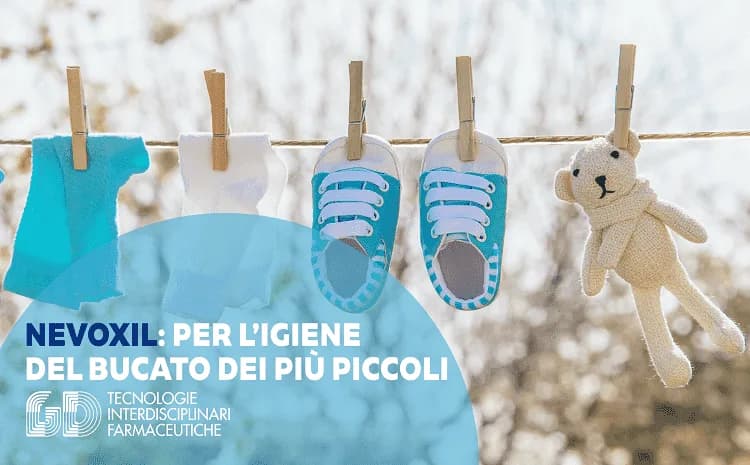
Simple rules for children's laundry
Little ones' laundry needs extra care to protect them from infections and irritation. Discover the sanitising power of Nevoxil
Young children's skin, especially that of newborns, is very delicate and reactive. During the first months of life, redness, irritation and even allergies are quite common.
That is why it is very important to choose carefully the clothes we dress our baby in and it is equally important, indeed essential, to ensure proper hygiene of the fabrics. It is not enough to wash them and remove every trace of dirt, from food stains to little spit-ups, from milk residue to felt-tip pen marks, not forgetting traces of sweat.
The most insidious enemies hide in the folds of the fabric, invisible to the naked eye. These are viruses and bacteria that settle on clothes and can survive for days or even weeks.
Think, for example, of Escherichia coli, which can cause urinary tract infections such as cystitis. Or Staphylococcus aureus, responsible for various skin infections that appear as impetigo, erythema or blisters.
Clothes that are not properly sanitised can become carriers of diseases of various kinds. It is therefore wise to take a few extra precautions to protect our children, whose defences are less effective.
So here are a few small tips for mums and dads tackling their children's laundry.
Always wash new clothes for babies and children
First essential rule: newly bought garments should always be washed before being worn. This, of course, applies not only to children's clothes but more generally to the clothes of every member of the family.
Particular attention, however, should be paid to the newborn's layette, which must be sanitised before use. This is because there may be residues of potentially harmful substances used to treat the fabrics. In addition, we do not know how the clothes were transported, how they were stored or how long they spent in the warehouse and the shop.
Whether it's a pair of pyjamas, a bodysuit or a winter hat, it's best to put everything in the washing machine.
High temperatures? No thanks
Contrary to popular belief, you don't need to set the washing machine to very high temperatures to kill germs and bacteria.
On the contrary, doing so could prove harmful in the long run. According to a study by Furtwangen University, in Germany, using high-temperature programmes to wash clothes could cause bacteria to proliferate, because it creates a warm, damp environment that favours these microorganisms.
The ideal temperature would be around 40°. Doing the laundry this way, with the right products, achieves an adequate level of hygiene while also saving money and protecting nature.
Washing at lower temperatures, in fact, helps keep energy consumption, and therefore bills, down. At the same time, it reduces the amount of carbon dioxide produced and the release of microfibres into the environment.
It's best to wash children's clothes separately
Another golden rule: it is best to keep children's clothes separate from those of other family members, especially when it comes to babies just a few months old. The clothes of mum, dad or older brothers and sisters could in fact harbour germs and other microorganisms that could also colonise the baby's sleepsuits, underwear and other clothing.
For this reason, it is a good idea to separate the garments not only during washing but also beforehand, by getting an extra laundry basket for the baby's clothes.
Watch out for soap and detergent residue
It's not just dirt. Even soap and detergent residue can trigger reactions on the delicate skin of babies and children. When you wash bibs, pants, dungarees and bodysuits, but also the removable fabric of the cot or the blanket you use in the pushchair, always rinse thoroughly so that no traces of detergent remain.
The most suitable detergent for children's laundry
Whether you choose a liquid laundry detergent or a washing powder, always pay attention to the ingredients. Reading the INCI list will help you understand whether that fabric hygiene product is suited to the needs of your child's delicate skin.
What characteristics should a laundry detergent for babies and children have?
- It must not contain chemical additives, petrochemical surfactants or dyes
- It must be fragrance-free
- It must be bleach-free
- It must be hypoallergenic
- It must be natural
These substances, in fact, are very harsh and can cause discomfort and irritation, even in children who do not suffer from allergies or atopic dermatitis.
For deep, safe hygiene of little ones' clothes and linen, we suggest using Nevoxil. It is our sanitiser based on sodium percarbonate, a molecule that releases nascent oxygen on contact with water and can act deep within the fabric fibres. It sanitises all garments, eliminating spores, fungi, cocci and bacteria.
It can be used in the washing machine, in addition to your usual detergent, or for hand washing, and it is effective even in water at 30° (or at low temperatures).
For any reports or complaints, please contact the owner of this website at gdtif@gditalia.biz