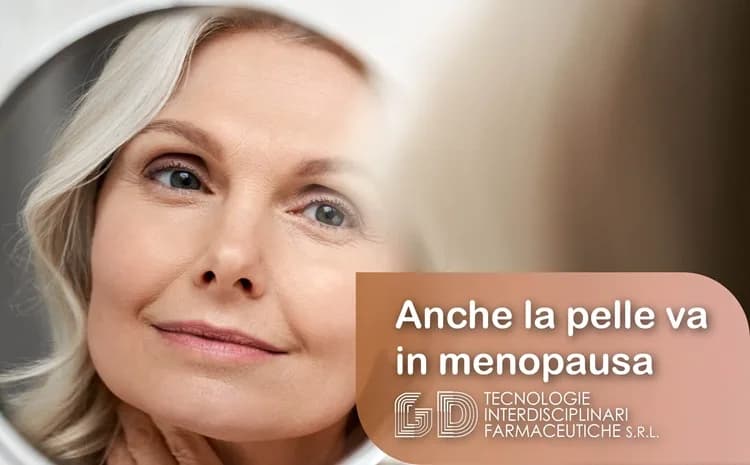
Skin in menopause: how to deal with itching, dryness and dark spots
Skin in menopause: how to deal with itching, dryness and dark spots
If you have recently entered menopause, you have probably already noticed some changes in your body.
Perhaps you find yourself waking up in the middle of the night with a feeling of unease you cannot explain.
Or you are at the office and suddenly feel a hot flush that leaves you breathless, forcing you to stop for a moment to regain control.
You may also have noticed recently that your skin has become drier and more fragile, or that dark spots have appeared that make your face look older.
These are common changes during menopause, caused by hormonal imbalances that affect the body, including the skin.
But don't worry!
There are effective solutions for taking care of yourself in this new phase of life, keeping your skin healthy and radiant.
Why does the skin change in menopause?
The skin goes through menopause too.
But why does this happen?
The main factor behind skin changes during menopause is the decrease in oestrogens, which, as well as regulating the menstrual cycle, play a fundamental role in skin health.
These hormones are essential for the production of collagen and elastin, proteins that give the skin tone, elasticity and strength.
With the onset of menopause, oestrogen levels drop sharply and this has an impact on the skin, which can lose compactness and tone, becoming less firm and more prone to sagging.
The consequences are clear: wrinkles and fine lines marking the face.
Menopause, however, does not only age the skin.
It also makes it more delicate and sensitive.
The drop in oestrogens also affects the skin's ability to maintain adequate hydration, resulting in skin that feels rough and tight, often accompanied by annoying itching.
Dryness is linked to a weakening of the skin barrier, which becomes less effective at protecting the skin from external agents such as UV rays, wind or the air pollution in our cities.
In more sensitive skin, these factors can not only trigger irritation and redness but also cause visible damage, speeding up the natural ageing process.
Dark spots are another “gift” of menopause.
Discoloured spots are usually due to excessive sun exposure and can also appear on young skin.
During menopause, however, the skin becomes more sensitive and tends to react differently to external stimuli, including sunlight.
Changes in hormone levels can also lead to an accumulation of melanin in certain areas, causing hormonal dark spots (so-called melasma) to appear, especially on the face, hands or other areas exposed to the sun.
How to care for your skin in menopause? Remedies for your discomforts
It is possible to counteract the effects of menopause on your skin.
To keep glowing after fifty, you need two things:
• careful skincare with specific products
• a healthy lifestyle
By adopting these two practices, you will be able to face the changes to your skin during menopause calmly and maintain your natural beauty as time goes by.
Here are our tips.
Relief for sensitive, dry and dehydrated skin and itching
To counteract dry skin during menopause, the products in GD Italia's AVEC line are an ideal choice.
This line is designed to offer deep hydration and protection, thanks to its formulation specifically for delicate skin.
In particular, we suggest using Avec Crema lenitiva decongestionante, suitable for dry, fragile skin that suffers from chronic irritation, dermatitis and other skin hyperreactivity.
In the case of very dry skin and a strong itching sensation, this product can be combined with Avec integratore. Its formulation contains Ceramosidi®, which can restore the skin barrier function, whose impairment is behind the feeling of dryness.
Ceramosidi®, in combination with Hyaluronic Acid, Biotin and Vitamin A, reduce water loss, helping the skin maintain proper hydration.
Preventing dark spots
As we have seen, the appearance of dark spots on the skin of women in menopause depends on the interaction between two main factors: hormonal changes and exposure to UV rays.
During menopause, the decrease in oestrogens affects melanin production, making the skin more prone to hyperpigmentation.
Add to this the effect of the sun's rays, including those we are exposed to unknowingly in everyday life, and the spots become more visible and persistent.
You cannot erase dark spots with a product… but you can stop them from appearing.
To prevent dark spots from appearing, you need a combined strategy: consistent sun protection and a skincare routine suited to the skin's new needs.
For photoprotection, we suggest two highly effective products, to be used together for the best result:
Tannidin Plus, a food supplement based on:
- Lycopene
- Polypodium, an antioxidant, which helps the trophism and functionality of the skin
- Lutein and Zeaxanthin from Tagetes erecta, an antioxidant that contributes to the wellbeing of eyesight
- Vitamin E, which contributes to the protection of cells from oxidative stress
- Selenium, which contributes to the normal function of the immune system
Tannisol SPF 25 Urban Protection, our innovative anti-ageing product for complete photoprotection all year round, based on DNA REACTIVATOR COMPLEX®, a latest-generation complex obtained by combining powerful active ingredients and broad-spectrum filters.
Loss of elasticity and thin skin
Ageing is normal.
But skin that is cared for ages differently, in a healthier way.
As the years go by, collagen and elastin production slows down, making the skin thinner, less toned and more prone to sagging.
This process is particularly evident during menopause, when the drop in oestrogens speeds up the loss of firmness and hydration.
To counteract the signs of time and live this period of your life calmly, you can ask your doctor or pharmacist whether ASSIST FORTE RETARD could help you.
ASSIST FORTE RETARD is the food supplement that helps make up for deficiencies or increased needs for specific nutrients at certain stages of a woman's life.
ASSIST FORTE RETARD contains:
- Genistein and L-Tryptophan
- Verbena extract, which counteracts menopausal symptoms and promotes relaxation and mental wellbeing
- Griffonia, which controls the feeling of hunger, contributes to normal mood and promotes relaxation (sleep)
- Tagetes erecta extract, standardised in Lutein, an antioxidant
- Niacin (Vit. PP) and Biotin, which contribute to the maintenance of normal mucous membranes and skin
- Vitamin D, which contributes to the maintenance of healthy bones and teeth, normal blood calcium levels and normal absorption of calcium and phosphorus
- Iron, which contributes to normal cognitive function and helps the normal function of the immune system
- Vitamin B6 and Folate, which help to reduce tiredness and fatigue and support normal psychological function
- Melatonin, which contributes to the reduction of the time taken to fall asleep. The beneficial effect is obtained by taking 1 mg of melatonin shortly before bedtime
Please note:
Information provided for informational purposes only, which cannot constitute a diagnosis, the prescription of a treatment or a substitute for direct contact with a doctor or a specialist visit. Always ask your doctor and/or specialists for advice.
For any reports or complaints, please contact the owner of this website at gdtif@gditalia.biz