Omega 3, 6 and 9: why are they so important for health?
Omega 3, 6 and 9 have a great many health benefits. Discover them in this in-depth look at polyunsaturated fatty acids.
The human body is often compared to a perfect machine.
Each of its structures, from the tiniest such as the cell to the largest (organs and systems), works together with the others in harmony. But for everything to run smoothly, this complex machinery has to be fed with the right “fuel”. In short, it needs to be given all the nutrients it needs to carry out its functions as well as possible.
Among the substances that are essential for our health are polyunsaturated fatty acids, that is, Omega 3, Omega 6 and Omega 9, which are part of what are commonly called “good fats”.
But what does that mean?
The importance of fats and the risks of excess
Although they are often spoken of in very negative terms, so much so that some people go as far as banning them from their diet, fats are in fact molecules that are indispensable to our body, with many different functions, just like proteins and carbohydrates.
To use a metaphor, they keep the human machine running and allow it to work well. Fats are in fact used by our body as its main source of energy when we are at rest or doing low to moderate intensity activities (walking, cycling, etc.).
In addition, fats are an important energy reserve.
If the body can survive even for whole days without food, it is thanks to the fat stores built up beforehand.
We are genetically programmed to store fat.
It is an ancient biological mechanism written into our DNA, as studies on evolution show. In prehistoric times, in fact, those energy reserves in the form of fat ensured our survival in an environment where food was not so easy to come by, especially in cold periods.
Today, however, we live in a world where resources are overabundant and all it takes is a trip to the supermarket to get them, and this natural mechanism (if not kept in check through a healthy diet) leads us to store too much, exposing us to metabolic syndrome, a clinical condition that predisposes to serious health problems: heart disease, diabetes, fatty liver…
But fats also play an important role in cell metabolism: some of them are precursors of substances that regulate our cardiovascular system, kidney function and the immune system.
A healthy, balanced diet, then, should never be without a proper intake of fats.
Good fats and bad fats: characteristics and differences
But not all fats are the same.
There are different types, and some of them, eaten in excessive amounts, can have negative effects on our health, setting the stage for various problems, some of them very serious.
What are commonly called “bad fats” are saturated fats, found in many foods we eat every day. Their most obvious feature to the naked eye is that they are solid at room temperature because they have a fairly high melting point.
These substances are not essential for the body: the human body is able to synthesise them on its own. As a result, there is no need at all to include them in the diet. On the contrary, excessive consumption of saturated fats is harmful because they are difficult to metabolise and tend to build up in the blood, raising levels of LDL cholesterol, the so-called “bad cholesterol”.
The result? An increased risk of cardiovascular disease and related conditions.
The main sources of saturated fats are animal-based. They are found in foods such as:
- butter, margarine, lard, back fat
- cured meats such as pancetta and sausages
- cold cuts
- full-fat cheeses (provolone, mascarpone…)
- fried foods
But saturated fats are also found in some plant foods such as:
- coconut oil
- palm oil
- cocoa butter
Even more harmful to health are trans or hydrogenated fats which come from an industrial process called hydrogenation. We find them in foods such as margarine, clarified butter and a range of processed vegetable oils used in the production of snack cakes, biscuits, sweet and savoury snacks, packaged crisps and other packaged foods.
According to experts, to stay healthy you should not exceed a daily amount of 2.5 grams of hydrogenated fats per day. Beyond this limit, the risk of developing conditions such as diabetes, cardiovascular disease (stroke, atherosclerosis) and even Alzheimer's increases considerably.
A recent study carried out by Kyushu University, in Japan, highlighted the link between excess trans fats and the risk of dementia.
But, as we have seen, fats should not be demonised across the board.
Rather, we should moderate our intake and above all try to include the “good” ones in our diet: unsaturated fats, divided into monounsaturated and polyunsaturated.
Among them are our Omega 3, Omega 6 and Omega 9.
Omega 3, Omega 6, Omega 9: functions, benefits and foods that contain them
Omega 3 and Omega 6 fatty acids are called essential because our body cannot produce them on its own.
Omega 3s have several functions, all extremely important.
In the form of triglycerides, they are a valuable energy reserve that the body can use when needed.
In the form of phospholipids, together with cholesterol and proteins, they make up the membrane of our cells, keeping it fluid and permeable. In this way, the membrane can best carry out its role as a selective filter: it lets only the necessary substances into the cell, keeping everything else out. They also act on the insulin receptors on the membrane.
Omega 3s, together with Omega 6s, also contribute to the normal functioning of the immune system, regulating inflammatory processes, and they also have an impact on metabolism, since they act on the concentration of fats in the blood, reducing it; they keep levels of “bad” cholesterol (LDL cholesterol) and triglycerides under control; and they raise levels of “good” cholesterol (HDL cholesterol).
For this reason, Omega 3s have a protective function for the heart and the cardiovascular system in general, which benefits from the intake of these fatty acids.
Omega 6s, on the other hand, are useful because:
- they support the immune system, regulating the production of inflammatory molecules;
- they keep veins, arteries and capillaries healthy;
- they stimulate the absorption of calcium into the bones, preserving the health of the skeletal system
- they keep the skin hydrated and protect it from skin ageing
Omega 9s too, in the right amounts, are a real boon for veins and arteries because they help reduce bad cholesterol, keeping the cardiovascular system healthy.
What should you eat to get Omega 3, Omega 6 and Omega 9?
We often hear that to stock up on Omega 3s, we should include at least 2 or 3 portions of fish a week in our diet.
It is true that oily fish (salmon, trout, mackerel, anchovies, pilchards and sardines) is rich in these substances, and fish oil is often used in supplements as a source of Omega 3.
But there are alternatives.
There are also various plant foods that provide good amounts of essential fatty acids and are a valid option for those who cannot or do not want to eat animal products.
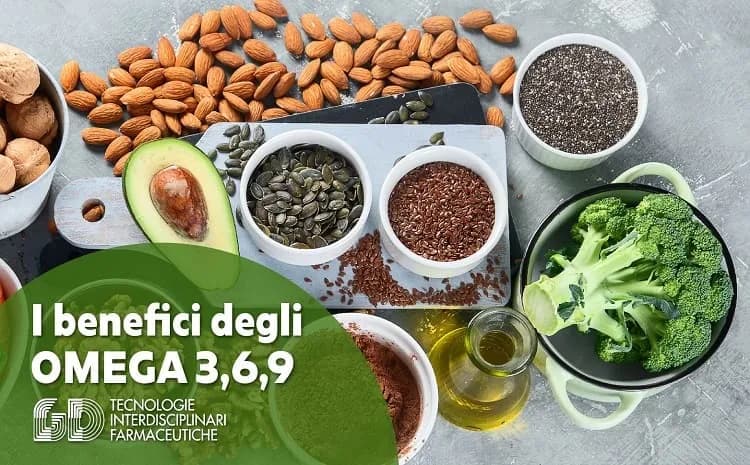
Plant sources of Omega 3 are:
- flaxseeds and the oils made from them
- chia seeds
- soya and soya products
- green leafy vegetables (rocket, spinach, etc.)
- walnuts
- pumpkin
The main sources of Omega 6, on the other hand, are plant-based:
- olive oil
- wheat germ oil
- flaxseed, sunflower, corn and soya oils
- nuts such as walnuts, peanuts and almonds
- pulses
Omega 9s, meanwhile, are found mainly in olive oil.
OMEGADIN, the food supplement that combines the benefits of Omega 3, 6, 9 with those of Red Orange Complex
One of the safest ways to take Omega 3, 6 and 9 in balanced amounts, making the most of their benefits without contraindications, is to choose a good supplement.
If you think you need support for normal metabolic function, or your latest tests have shown raised cholesterol and/or triglycerides, you can ask your doctor or pharmacist whether OMEGADIN PLUS RETARD could help you.
It is a food supplement free from any ingredient of animal origin, formulated with:
UNSATURATED FATTY ACIDS OF THE PLANT-BASED Ω 3, Ω 6 AND Ω 9 SERIES OBTAINED FROM THE SEED OIL OF THE PLANT BUGLOSSOIDES ARVENSIS AND FROM THE OIL OF OLIVES: REPLACING SATURATED FATS WITH UNSATURATED FATS IN THE DIET CONTRIBUTES TO THE MAINTENANCE OF NORMAL BLOOD CHOLESTEROL LEVELS (MONOUNSATURATED AND POLYUNSATURATED FATTY ACIDS ARE UNSATURATED FATS).
VITAMIN E, VITAMIN C AND SELENIUM CONTRIBUTE TO THE PROTECTION OF CELLS FROM OXIDATIVE STRESS.
IN ADDITION, VITAMIN C CONTRIBUTES TO NORMAL COLLAGEN FORMATION FOR THE NORMAL FUNCTION OF BLOOD VESSELS AND, WITH SELENIUM, CONTRIBUTES TO THE NORMAL FUNCTION OF THE IMMUNE SYSTEM.
RED ORANGE
The Vegan Lifestyle is one of the pillars of our philosophy, an ethical choice we believe in deeply.
That is why OMEGADIN PLUS RETARD, unlike the classic fatty acid supplements on the market, contains no fish oil or other ingredients of animal origin.
Instead, after research and testing, we chose to use Ahiflower® oil, a refined oil produced from the seeds of the plant Buglossoides arvensis, extremely rich in essential fatty acids (60% omega-3; 15% omega-6; 6% omega-9).
Another key contribution comes from olive oil, the liquid gold of the Mediterranean, with its scent of history and tradition, which confirm the extraordinary properties of this precious product of the land.
Please note
Information provided for informational purposes only, which cannot constitute a diagnosis, the prescription of a treatment, or a substitute for a direct relationship with your doctor or a specialist visit. We always recommend asking for the advice of your own doctor and/or specialists.
For any reports or complaints, please contact the owner of this website at the email address gdtif@gditalia.biz