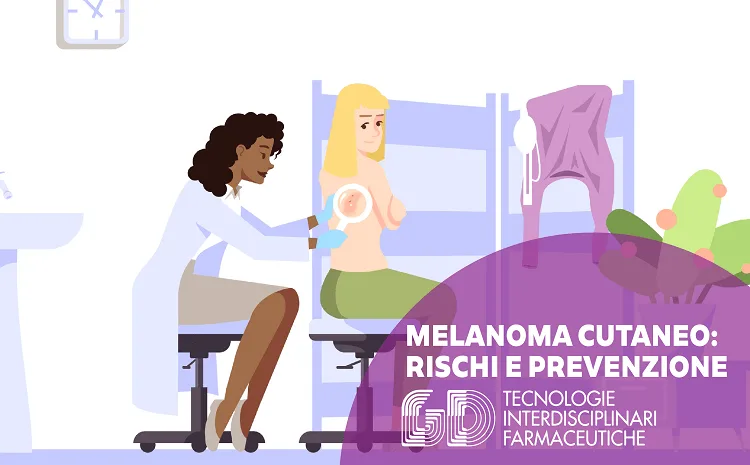
Melanoma: risk factors and prevention
Melanoma is a skin cancer that arises from changes in melanocytes. Discover the risk factors and how to protect yourself
Sun: friend or foe of the skin? This was the question we answered in one of our previous articles, published exactly a year ago, also in June.
Now that summer is just around the corner and we start thinking about how to get ready for a tan, we would like to return to those reflections. We have said many times that, however pleasant it may be to sunbathe for hours, sun exposure should always be safe and protected.
The ultraviolet rays can cause very serious damage to our skin, even to the point of leading to the development of melanomas.
What is melanoma?
Melanoma is a skin cancer that arises from changes in melanocytes, the cells responsible for producing melanin. This is the pigment that gives our skin its natural colour and has the function of protecting it from the sun's rays.
Melanoma usually affects adults, particularly in the 30 to 70 age group. However, younger people and children are not immune.
The sun, the main risk factor for melanoma
In 2020, there were an estimated 14,900 new cases, around 20% more than the previous year. As experts have pointed out, this increase can be explained in two ways.
On the one hand, there is greater effectiveness of awareness campaigns, which encourage people to have their moles checked. This brings to light cases that previously went undiagnosed.
On the other hand, however, the increase in melanoma cases is linked to a certain spread of incorrect behaviour and bad habits when it comes to sun exposure.
In fact, ultraviolet radiation is the main cause of this skin cancer.
Why?
Because by penetrating deep into the skin, it can alter the DNA of cells and cause them to degenerate. This does not only happen with the sun's rays. Even when lying on sunbeds or using tanning lamps, you are exposed to a large amount of UV rays.
That is why these devices should be used in moderation, without overdoing it.
Some groups of people are more predisposed, both because of personal characteristics and because of “events” that have happened during their lives.
All those who have a fair complexion, light hair and light eyes (classified as phototype 1-2) are twice as likely to develop melanoma as people with darker/olive skin and black eyes and hair.
Then there is family history. If there is already a case of melanoma in the family, the risk is higher.
You should also keep an eye on the number of moles. The cancer can develop from naevi (or moles) already present on the skin, which in some cases can be precursors of melanoma. For this reason, it is advisable to carry out a careful inspection of your moles and see a dermatologist if you notice any abnormalities.
One of the tools for early diagnosis of melanoma, which anyone can use as a guide, is the ABCDE rule, an acronym indicating the characteristics to consider:
- A for Asymmetry: a benign mole has a symmetrical shape, usually circular or at least roundish, whereas melanoma is asymmetrical;
- B for Borders: a benign mole has regular borders. Melanoma has jagged borders
- C for Colour: a mole has an even colour, whereas melanoma shows different shades of colour
- D for Diameter: generally a mole grows to a maximum diameter of 6 millimetres. Anything larger than this should be checked, especially if it has the characteristics described in the previous points of this list (Asymmetry, jagged Borders and abnormal Colour)
- E for Evolution: if a mole or pigmented spot grows rapidly, it could be a melanoma
Genetics also plays a part. In particular, people with mutations of the CDKN2A gene have around a 70% risk of developing melanoma during their lifetime.
Added to all these causes are hereditary diseases and immune system deficiency problems.
But particular events in your life can also have an influence and increase the chances of developing this type of skin cancer. We are talking about sunburn, which is often “collected” especially during childhood.
These skin lesions should not be underestimated at all. Of course, the burn heals, but our skin remembers: a trace remains imprinted on it which, in the long run, can lead to the formation of a melanoma.
Melanoma: prevention is essential
Given the characteristics of melanoma and all the risk factors, we can say that there are two paths to prevention.
On the one hand, you need to have check-ups so as to achieve an early diagnosis and act in time. On the other, you need to behave correctly when it comes to sun exposure:
- Avoid sun exposure during the hottest hours of the day, from 10.00 in the morning until mid-afternoon
- Limit the use of sunbeds and tanning lamps
- Always use sun protection suited to your phototype, remembering to reapply the cream often to ensure constant coverage. This should be a daily precaution, a good habit to acquire for life. The sun is not only harmful in summer, but at all times
- Before going out in the sun, it may be useful to prepare your skin, by taking a specific food supplement such as Tannidin Plus, which works like a total screen, protecting the skin and eyes from the damage caused by photoexposure. In particular, Tannidin proves very useful for preventing sunburn and erythema which, as we have seen, can in the long run predispose us to developing melanoma
For any reports or complaints, please contact the owner of this website at gdtif@gditalia.biz