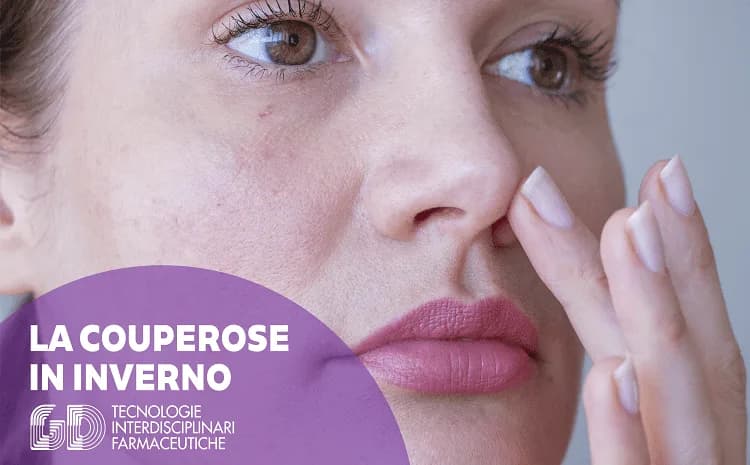
Couperose in winter
Couperose is an inflammatory skin condition that brings a lot of discomfort. Find out how to tackle it with GD remedies
Red patches on the face, on the cheeks, near the nose and on the chin? This is how couperose shows itself. It is a skin lesion that appears as an abnormal dilation of the capillaries and venules of the face due to the skin's thermal sensitivity.
This skin inflammation is quite widespread.
In Italy, over 3 million people develop this inflammatory skin condition. Most of them are women over the age of 30.
Those most at risk are people with fair, thin, sensitive skin that is easily irritated.
The cold, an enemy of the skin
With the arrival of the cold season, people with couperose know they will face a difficult period.
The cold puts our skin to the test.
When temperatures drop, in fact, our body reacts by trying to conserve heat and protect the vital organs, such as the heart and brain. To do so, it activates the particular mechanism known as vasoconstriction, that is, it narrows the small blood vessels that carry blood, oxygen and nourishment to the various parts of the body, channelling the nourishment to the most important parts.
The skin is, in a sense, cut off from supply and, for this very reason, slows down its metabolism. As soon as we enter a heated space or perhaps have a hot drink, the opposite mechanism is triggered, that is, vasodilation. The capillaries, back to their usual volume, supply the skin with renewed energy.
Because of these continual temperature changes, then, our capillaries narrow and dilate over and over again during the day. It is a kind of seesaw that can cause damage and lesions to already fragile and weakened capillaries, which are unable to react effectively.
This is why couperose appears mainly during the cold months, bringing discomfort and irritation: skin reddened by networks of dilated small veins and capillaries surfacing, and a burning sensation. At first, the symptoms are short-lived. The redness is temporary and the surface blood vessels, after dilating, return to their usual size. But over time, because of the continual imbalances, the redness becomes persistent and telangiectasias form.
Tips and remedies for skin affected by couperose in winter
What can you do to prevent couperose?
How can you keep your skin safe from this disorder, especially during the winter season?
The first step is to protect the skin of the face from low temperatures. The simplest and most immediate way to do this is to wrap up in a warm scarf, worn so as to cover the face and expose it as little as possible to cold, damp air.
It is best to avoid any kind of skin stress, including direct exposure to UV rays. As we have stressed many times, solar radiation is not something to fear only in the warmer months, when we feel the heat of the rays on bare skin. You should protect yourself all year round, even in winter, using sunscreens suited to your phototype.
Another useful aid in defending yourself against couperose is the use of cosmetic products for dry skin, which is more prone to this kind of irritation.
Very useful are soothing, decongestant and anti-inflammatory creams such as Avec Crema, a specific remedy for dry, fragile skin suffering from chronic irritation such as couperose.
Its tested effectiveness is based on a formulation containing active ingredients such as Zanthalene and Glycyrrhetinic acid, which can soothe the burning sensation on the skin caused precisely by temperature swings with sudden changes from cold to warm and vice versa. As well as providing relief, Avec Crema also has a protective action against external irritants (cold, wind, rain etc).
Since we are dealing with a skin disorder linked to circulation problems, in some cases it may be useful to add a food supplement to the therapy, such as Angioton Plus Retard, created to improve capillary permeability and resistance. This 100% vegan food supplement, with plant extracts of red vine, bilberry, melilot, birch, centella and horse chestnut, acts as a vasoprotector and helps to resolve alterations and abnormalities of the microcirculation.
Lifestyle habits have a strong influence on the health of our skin.
For this reason, to keep couperose and its symptoms under control, it is also advisable to adopt a balanced diet, favouring foods such as oily fish, fresh fruit, pulses, wholegrain cereals, vegetables and extra virgin olive oil.
It is also good to include in your diet foods rich in vitamin C, since a deficiency can cause capillary fragility. So we can bring to the table: citrus fruits such as oranges, grapefruits and mandarins; kiwis, apples, lettuce, peppers and broccoli. To be sure of preserving the properties of the food and taking in all the nutrients, it is always best to eat most of these foods raw. Where that is not possible, choose steaming.
Antioxidants are also valuable allies, very useful for circulation.
Drink alcohol in moderate amounts and never before exposing yourself to very cold temperatures. To be clear, if you go on a mountain holiday and are planning a nice day in the snow, drinking mulled wine before putting your skis on is not recommended at all.
Better not to overdo it with food, avoiding binges. Hot spices such as pepper, chilli and ginger, and stimulating drinks such as coffee, are also not recommended.
For any reports or complaints, please contact the owner of this website at the email address gdtif@gditalia.biz