Sun intolerance: remedies for photoallergy
If you suffer from sun intolerance, spring is a critical time. Find out how to protect yourself from photoallergy and enjoy the warmer months
The arrival of spring, for many, means the long-awaited return of the sun's rays, hidden for too long behind the heavy clouds of the winter sky. The warmth invites us to leave behind jumpers and padded jackets and wear lighter, cooler clothing that lets our skin breathe, allowing it to enjoy the light and warmth.
This, however, is not true for everyone.
For a number of people, in fact, the start of the warmer season brings a real challenge, a source of difficulty and discomfort: sun intolerance.
Sun intolerance (commonly called sun allergy) is a condition of hypersensitivity to solar radiation that can trigger very painful skin inflammation.
When exposed to UV rays without adequate protection, the skin of people with this condition becomes irritated and reacts with redness, severe itching and often blisters and bullae.
To treat sun intolerance properly, it is essential to fully understand its causes, symptoms and management strategies so as to ensure optimal wellbeing during spring and beyond.
In this article, we will explore sun intolerance in detail, providing in-depth information and practical advice for those affected, and also pointing out the most suitable products to prevent the disorder at the times (and in the places) where solar radiation is at its strongest.
Sun intolerance: the different types
First of all, it is important to understand that the umbrella term sun intolerance or sun allergy covers different disorders, which share the same trigger, namely direct exposure to the sun's rays.
The main forms of sun allergy are:
- polymorphic light eruption
- hereditary polymorphic light eruption
- photoallergic dermatitis
- solar urticaria
Forms of sun intolerance: Polymorphic light eruption
Among the various skin conditions grouped under the term “sun allergy”, polymorphic light eruption (PLE) is one of the most common and widespread. It is an acute skin reaction that occurs after exposure to sunlight or UV lamps, characterised by an itchy, red rash, sometimes associated with blisters.
This condition is thought to be caused by an abnormal reaction of the immune system to sunlight, which triggers a series of inflammatory processes in the skin.
Polymorphic light eruption is more common in women and in people with phototype 1, who have a fair complexion and delicate skin.
Forms of sun intolerance: Hereditary polymorphic light eruption
The symptoms of hereditary polymorphic light eruption are the same as those of the non-hereditary form of the condition, but they are more acute and intense and often tend to appear early, in early childhood or during the teenage years.
As the name suggests, this type of intolerance to the sun's rays has a genetic component.
Forms of sun intolerance: photoallergic dermatitis
So-called photoallergic dermatitis, or photodermatitis, is a form of intolerance to the sun's rays triggered by the interaction of UV rays with chemical substances or medicines taken orally or applied directly to the skin.
These substances react with sunlight, triggering a phototoxic reaction that can damage skin cells and tissues, with the onset of severe inflammation that shows itself through symptoms such as redness, swelling, burning and small blisters.
Forms of sun intolerance: solar urticaria
Solar urticaria is a skin condition characterised by itchy rashes, swelling and redness that occur quickly after exposure to sunlight.
This allergic reaction is caused by the direct stimulation of the skin by UV rays, which triggers an immune system response. People with solar urticaria may develop symptoms within a few minutes of sun exposure and may experience considerable discomfort during the episode of urticaria. Exposed areas, such as the face, neck, arms and legs, are often the most affected.
How can you tell if you are allergic to the sun? The symptoms
As we have pointed out, there are different forms of sun allergy or intolerance, distinguished by certain specific features. So the symptoms can also vary in form, duration and intensity, depending on the underlying disorder, and can appear quickly, within a few minutes of sun exposure, or develop after several hours, when you have already moved away from the light source.
However, they are always skin manifestations, which may include:
- redness
- itching
- swelling
- blisters or bullae
It is important to recognise and carefully monitor these signs in order to identify photosensitivity early and take the necessary measures to protect the skin and prevent any adverse reactions.
Why do people become allergic or intolerant to the sun?
There is no single answer to the question: “Why do people become allergic to the sun?”
Experts agree that the causes of the disorder are not certain.
In some people, photosensitivity is genetically determined. In others, it is triggered by photosensitising medicines, such as some antibiotics, diuretics and non-steroidal anti-inflammatories, and by skin care products such as creams and perfumes that contain chemicals able to interact with the skin.
We can say that the abnormal skin reaction seen in people with sun intolerance is mediated by the immune system, which recognises certain skin components exposed to ultraviolet radiation as foreign and consequently activates an inflammatory response.
Treating sun allergy
Understanding the various conditions associated with sun intolerance is essential for an accurate diagnosis and targeted treatment. If you have symptoms that may suggest a sun allergy, it is always best to see your trusted dermatologist.
The doctor will be able to carry out a specialist examination, assessing the individual case and suggesting the most suitable treatment, which may include the use of broad-spectrum sunscreens, protective clothing and, in some cases, anti-inflammatory or immunosuppressant medicines to be taken under their supervision.
Whether the form is mild or severe, in any case, people who suffer from sun intolerance need to protect their skin, not only in the warmer months but all year round, so as to prevent the harmful effects of UVA and UVB rays.
Solar radiation is always present and acts even when we do not notice it, whenever we are outdoors and exposed to natural light: when we go shopping, when we walk the dog, when we go jogging, while taking the children to school…
Preventing photoallergy: protecting yourself from sunburn and solar dermatitis with the right products
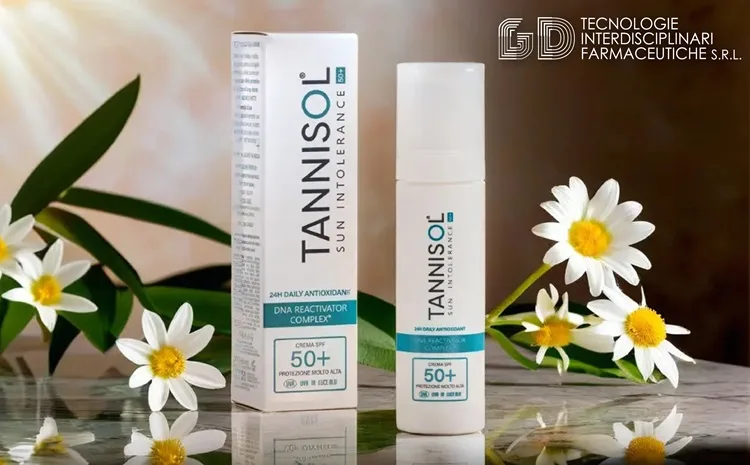
That is why our experts developed TANNISOL CREMA SPF 50 + SUN INTOLERANCE, the very high protection factor cream specifically formulated for cases of sun intolerance, with antioxidant and anti-ageing effect.
Avoiding the sun altogether is not the solution, as you would also miss out on the beneficial effects of solar radiation. With TANNISOL CREMA SPF 50+ SUN INTOLERANCE you can go back to enjoying daylight without fear of side effects.
Its formulation is the result of months of research and study, which led to the creation of DNA REACTIVATOR COMPLEX®, an advanced protection, prevention and repair system, patented by GD. This latest-generation complex, based on powerful natural extracts such as Phytoplankton extract, Polygonum aviculare extract and Theobroma cacao extract, together with other selected broad-spectrum filters, can protect and repair skin DNA damaged by the sun's rays, while at the same time counteracting the effect of free radicals, which are responsible for premature skin ageing.
TANNISOL CREMA SPF 50+ SUN INTOLERANCE ensures total coverage across the entire electromagnetic spectrum, defending skin that suffers from sun intolerance not only from UV rays but also from environmental agents and oxidative stress, thus counteracting the appearance of wrinkles, dark spots (hyperpigmentation) and loss of skin elasticity, keeping skin young for longer.
Thanks to these special characteristics, TANNISOL CREMA SPF 50+ SUN INTOLERANCE is also particularly suitable in the case of skin changes linked to hormonal imbalances, such as those that occur during menopause or following the use of certain medicines, such as oral oestrogen-progestogen contraceptives, which can make the skin photosensitive, leaving it more susceptible to the sun's rays. In addition, TANNISOL can be used to protect scars, including after surgery.
The formulation is enriched with Vitamin E, which counteracts the signs of time and prevents skin sagging, and Shea butter with a soothing and antibacterial action, and contains filters that respect the environment and the marine ecosystem.
You could combine this with a supplement.
If you have delicate skin that turns red as soon as you get a little sun;
if you know that ultraviolet radiation (UV rays) can have harmful effects on the skin and you want to protect it;
if glare, artificial light and car headlights bother you;
if you spend a lot of time in front of a PC monitor, LED TV or smartphone and your eyes get red;
if you know that diet can be an ally during sun exposure, then you can ask your doctor or pharmacist whether TANNIDIN PLUS supplement could be useful for you.
TANNIDIN PLUS is a food supplement formulated with active ingredients of plant origin, vitamins and minerals such as:
• Lycopene
• Polypodium, an antioxidant that helps the trophism and functionality of the skin
• Lutein and Zeaxanthin from Tagetes erecta, an antioxidant that contributes to the wellbeing of eyesight
• Vitamin E, which contributes to the protection of cells from oxidative stress
• Selenium, which contributes to the normal function of the immune system
Please note:
Information provided for informational purposes only, which cannot constitute a diagnosis, the prescription of a treatment or a substitute for direct contact with a doctor or a specialist visit. Always ask your doctor and/or specialists for advice.
For any reports or complaints, please contact the owner of this website at gdtif@gditalia.biz