Stopping the atopic march: what every allergy sufferer should know
If you suffer from atopic dermatitis, you are also at risk of developing other conditions such as bronchial asthma. Find out how to stop the atopic march
Atopy and the allergic triad
Atopic dermatitis, allergic rhinitis, bronchial asthma. On the face of it, these conditions seem to have nothing in common.
Atopic dermatitis is an inflammatory skin disease that shows up as redness, itching and sometimes skin rashes.
Allergic rhinitis, on the other hand, affects the nasal mucosa and the throat and is triggered by various substances called allergens.
Something else again is asthma, which affects the bronchi.
Despite appearances, however, these different conditions are deeply connected.
It is no coincidence that experts call them the “allergic triad”.
All of them, in fact, involve an exaggerated immune reaction that overreacts to certain substances normally found in our environment and in theory completely harmless: pollen, pet hair, moulds, dust mites or particular textile fibres.
This condition of extreme sensitivity to the substances that come into contact with our body has a name: atopy, which literally means “out of place”.
The atopic march: if you or your child have atopic dermatitis, you could also develop these other conditions
An atopic person has a genetic (inherited) tendency to develop allergic diseases, which may also appear in sequence.
This is what is called the atopic march, a term that describes the progression of these related conditions, which appear one after the other, following a kind of pattern:
- atopic dermatitis
- allergic rhinitis
- bronchial asthma
The start of the atopic march: dermatitis in young children
The first to appear is atopic dermatitis and marks the first months of life of a great many children, with very visible and extremely bothersome symptoms. This condition is associated with a deficit in the skin's barrier function, with a loss of hydration.
There are two main consequences: on the one hand, extremely dry skin, together with redness and above all that intense itching that torments the skin and never finds relief; on the other, greater permeability of the epidermis, which more easily lets in foreign substances from outside that can trigger the inflammatory process.
The itching becomes more intense at night, making it impossible to rest peacefully. Children with atopic eczema (and adults too) often find it harder to fall asleep, wake up several times and may even suffer from sleep apnoea.
If the atopic march continues: allergic rhinitis and asthma
In many cases, the onset of atopic dermatitis in early childhood coincides with sensitisation to certain substances found in the home.
If you have recently had a baby, you probably know that the first months of life are a critical period. Their immune system is still very immature and has yet to learn to recognise and distinguish what may be harmful from everything else, developing the antibodies needed to protect the body from pathogens and disease.
Early exposure to certain foods such as nuts, cow's milk or eggs can profoundly influence the development of their defences, shaping the response the body will give in the future.
And so the young child starts to feel unwell on contact with these and other substances found in the home, such as dust mites or the hair of the dog or cat that lives with your family.
Just when you thought the dermatitis was finally disappearing, allergic breathing problems appear: allergic rhinitis and asthma. Suddenly, the child seems short of breath, struggles to breathe in, coughs and cannot carry out normal daily activities.
And at night it is even worse.
As children grow, the various symptoms tend to ease until they disappear. However, in at least 20% of cases they continue into adolescence. In fact, allergic symptoms very often come back after a few quiet years in which the problem seemed to have gone away completely.
Atopy and allergic symptoms in adulthood
Allergic problems can appear at any age, even in adulthood, following exposure to certain environmental factors, as a result of particular lifestyles or cigarette smoke.
Usually, people suffer from one or two atopic diseases, which may appear at the same time or one after the other, some time apart.
But why does this happen and what can be done to stop the atopic march? Read on to find out.
What factors influence atopy?
You should know that atopy is influenced by various factors which, interacting with one another, give rise to this condition.
As we said at the beginning, one of the main causes is genetic predisposition. If one or both parents suffer or have suffered from allergies in the past, there is a high risk that the child will also develop atopy.
A child with an atopic parent is 30% more likely to inherit this trait.
However, mum or dad do not necessarily have to show signs of atopic eczema or asthma for there to be a genetic predisposition. Sometimes they are “healthy carriers”, meaning they carry genes in their chromosomes that make their children more susceptible to allergies.
There is no single atopy gene.
At the root of the problem, in fact, there is a combination of several genes involved in regulating the immune response, among which those coding for immunoglobulin E (IgE), the antibodies responsible for regulating allergic responses, are certainly important.
Mutations or variants of these genes can influence the production of immunoglobulins and their function, which is enhanced, triggering strong allergic symptoms.
However, heredity is not enough: the conditions of the surrounding environment also play an important role in the development of atopic disease.
What are we talking about?
First of all, early exposure to allergens, which a young child often comes into contact with both outside and inside the home.
Secondly, air pollution.
The air we all breathe every day, especially if we live in large, busy cities, is full of toxic substances, fine particulates and chemicals that can compromise our health, causing inflammation of the airways and the skin.
In children, all this greatly increases the risk of developing allergic diseases.
Lifestyle also has an impact.
We know that breastfeeding can have a protective effect, reducing the risk of developing atopy and food allergies. Breast milk in fact contains certain ribonucleic acids that stimulate the development of the newborn's gut microbiota. On the other hand, some research seems to suggest that formula milk may not be as effective, causing alterations that change immune development.
In addition, the introduction of solid foods or a diet rich in allergenic foods can lead to a greater risk of allergy.
How to stop the atopic march
At this point you may be wondering how it is possible to slow down or even stop the atopic march, so that you or your child do not have to experience the consequences of conditions such as dermatitis, asthma or allergic rhinitis.
A doctor who is trained and up to date with the latest research is certainly a valuable ally in the battle against atopy. An experienced professional, whether a dermatologist, allergist or immunologist, is the only one who can help you understand the situation, making an accurate diagnosis that takes into account the triggers of the allergy and then giving you information on the possible treatments.
Each of us is a case in our own right, which must be assessed carefully before any treatment can be recommended.
What is certain, though, is that you can take some precautions to prevent symptoms from appearing:
- reduce exposure to known allergens such as pet hair or mites;
- adopt a healthy lifestyle: by exercising and eating well, following a balanced and varied diet, you help keep your gut microbiota healthy and strengthen your natural defences, stimulating your immune system;
- learn to manage stress: stress is part of life and cannot (and should not) be eliminated, as it is a vital stimulus. However, we need to learn how to manage it in a healthy way, avoiding overload that can compromise our health;
- take medicines only under medical supervision, avoiding self-medication
In case of established atopy and atopic dermatitis, you can try the combined action of the products in the Avec line, developed in the GD laboratories:
Avec Detergente Mousse, a soft cleansing foam for the gentle cleansing of reactive, sensitive and allergic skin that needs a gentle touch;
Avec Crema and Avec Emulsione, soothing and decongesting, to be applied to the skin when itching and irritation become too intense
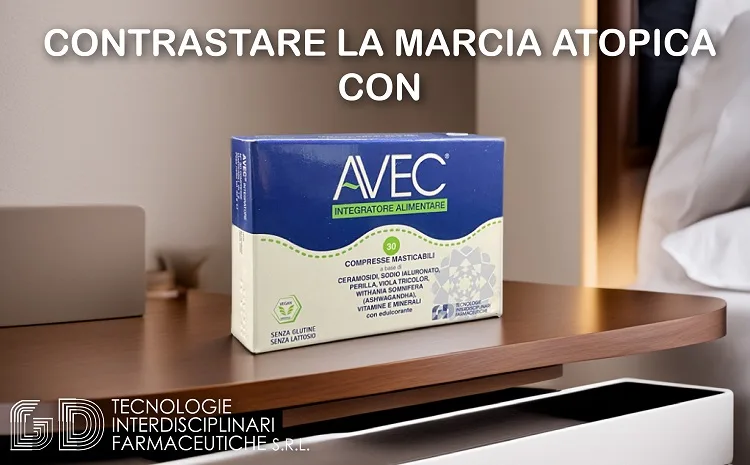
Avec Integratore, the latest development in atopic dermatitis, able not only to act against dryness, itching and inflammation, but also to stop the atopic march
Please note
Information provided for informational purposes only, which cannot constitute a diagnosis, the prescription of a treatment, or a substitute for a direct relationship with your doctor or a specialist visit. We always recommend asking for the advice of your own doctor and/or specialists.
For any reports or complaints, please contact the owner of this website at the email address gdtif@gditalia.biz