Summer in the mountains. The beauty routine for high-altitude-proof skin
Heading to the mountains this summer to escape the heat? Before you leave, discover our high-altitude-proof beauty routine.
In summer, the mountains offer everything you need for a truly relaxing holiday, far from the chaos of big cities or crowded beaches: breathtaking views, wholesome, hearty dishes to recharge after a tiring trek, plenty of unspoilt nature…
Even at high altitude, however, you should not neglect your skincare.
A summer beauty routine suited to the environment and the particular conditions of the mountains is essential to come home at the end of your holiday with lots of happy memories and healthy, radiant skin.
First of all, let's look at the factors to bear in mind when we choose to spend our days on the peaks.
Sun at high altitude: the dangers of tanning in the mountains
We all know that the sun can have very negative effects on the skin. Its rays not only cause premature ageing of our skin (photoageing) but also lead to degeneration of cellular DNA, which is altered and irreversibly damaged.
What, unfortunately, we do not realise is that this harmful action of UV rays does not only occur in summer, on sun-drenched beaches at 40° in the shade.
Solar radiation is always present, all year round and in every environment, and it hits us while we are busy with all kinds of activities (while we go grocery shopping, while we walk the dog, while we play with the children in the garden, while we go shopping…)
This also applies to the mountains. In fact, in the mountains it is even more important to be careful about sun exposure.
At high altitude, in fact, the action of ultraviolet rays is much more intense than it seems.
The higher the altitude, the thinner and less polluted the air, which reduces the amount of UV rays absorbed by the atmosphere, allowing a greater percentage of rays to reach the Earth's surface.
It is estimated that for every 1000 metres of elevation, UV levels increase by about 10-12%. This means the skin is exposed to a significantly greater amount of harmful radiation than at sea level.
In addition, snow and ice, where present, produce a mirror effect, reflecting solar radiation.
As a result, contrary to popular belief, skin is more likely to redden or burn in the mountains, especially on days when a few clouds veil the sky, giving us the illusion that the sun is not there.
Sunburn and erythema are not just a cosmetic problem.
Several studies have shown that sunburn, especially at a young age, can increase the risk of developing melanoma and other skin cancers.
So whether you want to go on a long hike or spend a few hours relaxing and tanning on a meadow, it is wise to protect yourself properly, applying a high protection factor cream several times.
Crisp air and temperature swings, enemies of the skin
There are two other factors to consider to prepare as well as possible for our summer in the mountains: the crisp air typical of the mountains and sudden changes in the weather.
At certain altitudes, the air is colder and drier than what we are used to at lower altitudes, in the city as well as by the sea. Dry air increases the evaporation of moisture from the skin's surface, leading to skin dehydration, which can make the skin dry and chapped and sometimes lead to irritation and redness.
Over time, dehydration accentuates the appearance of fine lines and wrinkles, making the skin look visibly aged.
In the mountains, moreover, it is normal for a sunny day with a clear sky to turn into a downpour and vice versa, especially as you start to climb. If we venture from the valley floor to high altitudes, above 1200-1800 metres, the temperature change makes itself felt and can cause quite a lot of discomfort to the skin, quickly dehydrating it.
Then there is the wind factor.
Exposure to cold, dry wind can damage the skin barrier, leading to greater moisture loss and making the skin more sensitive to external agents and therefore prone to redness, irritation and inflammation, especially in the most exposed areas such as the face and hands.
Beauty routine for summer in the mountains. Here's how to protect your skin during holidays among mountain huts, alpine pastures and alpine lakes
If you have read the previous paragraphs, you will have understood why it is necessary to adapt your summer beauty routine to the mountains.
Good skincare, kept up over time, can allow your skin to stay young for longer, or rather to age healthily, preventing the appearance of deep wrinkles, dark spots and other skin imperfections, as well as more serious skin problems.
What is the first step?
Cleansing, of course.
Summer in the mountains: deep but gentle cleansing
In the mountains, the skin is exposed to sweat, dust and sunscreen residue, which can build up on the skin, preventing it from “breathing”, clogging pores and triggering the proliferation of the bacteria that cause acne.
Effective but gentle cleansing is essential to remove these impurities without damaging the natural skin barrier that protects our skin.
But which product should you choose for the first step of your summer beauty routine in the mountains?
We recommend Rebioger Aqua Dermopurificante Essenziale, an ultra-gentle cleanser based on plant extracts, with an anti-ageing, toning and regenerating action on the skin.
Thanks to its specific formulation, Rebioger Aqua Dermopurificante not only removes dirt without affecting the hydrolipidic film, but also helps you counteract skin ageing.
Orange blossom extract tones and regenerates the skin, while chamomile extract stimulates the function of the skin's microcirculation and promotes the synthesis of collagen, the protein responsible for the skin's elasticity and tone.
Summer in the mountains: intense hydration with face cream and serum
As we have seen, high altitude and the dry air typical of mountain environments tend to dry out the skin, dehydrating it.
That is exactly why, if we choose to spend our summer holidays on the peaks, it is wise to get ready in good time and take with us a moisturising cream to apply morning and evening to keep the skin supple and radiant, a sign of healthy skin.
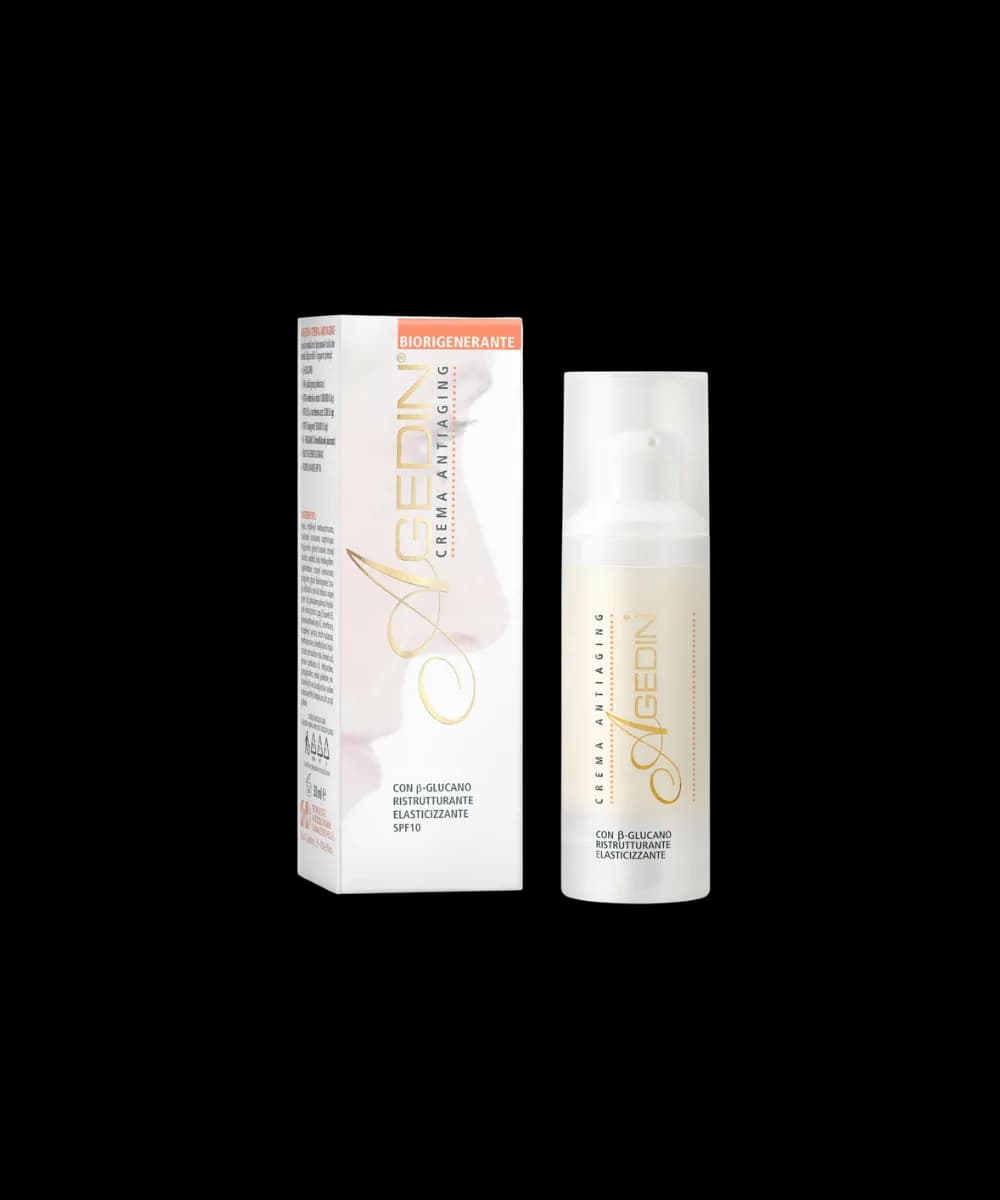
Our choice is Agedin Crema, an anti-ageing cream with a restructuring and elasticising action. It hydrates, nourishes and regenerates, counteracting the formation of wrinkles and protecting the skin.
It can be combined with Agedin Siero Idrotensore, our special intensive anti-ageing treatment, very rich and moisturising, with a lifting and plumping action on the skin of the face, neck and décolleté.
Its main ingredient is hyaluronic acid microspheres, a brand-new technology that delivers the active ingredient more effectively, penetrating deep into the epidermis, plumping the skin from within and filling wrinkles, folds and furrows.
Hyaluronic acid is known for its ability to retain large amounts of water, improving skin hydration at both surface and deeper levels. Using the serum under your moisturiser can prove the winning move to maintain proper hydration during your summer in the mountains.
After cleansing, apply the serum to the skin, followed by the richer moisturiser to seal in moisture. This method will help you stay hydrated for longer.
Adopting a targeted cleansing and moisturising routine not only helps keep the skin healthy and hydrated, but also prepares it for optimal protection against the environmental challenges of the mountains. By using the right products and following these steps, the skin can stay fresh, radiant and well protected throughout your stay at high altitude.
Remember, though, that to be truly safe from the elements, especially the sun, your skin needs another valuable ally: protective cream.
Summer in the mountains: how to avoid sunburn and erythema at high altitude
Since the sun's rays hit harder at high altitude, using adequate sun protection is essential to prevent skin damage.
But which one to choose?
GD recently launched TANNISOL, a revolutionary line of photoprotection products, designed to offer advanced sun protection combined with additional benefits for the skin, making it ideal for those looking for effective solutions against damage caused by UV rays.
Their remarkable effectiveness, proven by numerous laboratory tests, is due to the DNA REACTIVATOR COMPLEX®, a latest-generation complex obtained by combining powerful active ingredients such as Phytoplankton extract and Polygonum aviculare extract with other selected broad-spectrum filters.
Thanks to this advanced system, TANNISOL CREMA SPF 25 URBAN PROTECTION AND TANNISOL CREMA SPF 50+ SUN INTOLERANCE are able to prevent skin damage caused by solar radiation and stimulate DNA repair. At the same time, both creams act as a protective shield for the skin against the harmful effects of the entire electromagnetic spectrum, from UVA and UVB rays to high-energy blue light and infrared rays.
The formulation of TANNISOL products is enriched with Vitamin E, which counteracts the signs of ageing and prevents skin sagging, Shea butter with a soothing and antibacterial action, and filters that respect the environment and the marine ecosystem.
TANNISOL is available in two versions with different SPFs.
TANNISOL CREMA SPF 25 URBAN PROTECTION is designed for photoprotection 365 days a year and is recommended:
- in case of photodamage and damage from environmental pollution
- For sensitive and fragile skin
- In case of skin alterations
- To counteract and reduce the visible signs of photoageing and loss of skin elasticity
- To prevent the appearance of dark spots (hyperpigmentation)
- As an aid in conditions that can benefit from exposure to ultraviolet light, such as heliotherapy and phototherapy, thanks to its ability to filter radiation and prevent damage
TANNISOL CREMA SPF 50+ SUN INTOLERANCE, on the other hand, is our very high protection factor cream, specifically formulated for cases of sun intolerance, with an antioxidant and anti-ageing effect, and is particularly recommended:
- In case of intolerance to the sun's rays
- To stimulate the repair of DNA damaged by sun exposure
- To counteract and reduce the visible signs of photoageing and loss of skin elasticity
- To prevent the formation of dark spots (hyperpigmentation)
- To protect scars, including after surgery
- Against skin changes due to menopause
- When taking oral oestrogen-progestogen contraceptives, which can cause photosensitisation
Ahead of your departure, we also suggest preparing for the mountain sun: you can ask your trusted pharmacist whether TANNIDIN PLUS, a supplement, can help you against the effects of solar radiation.
Please note:
Information provided for informational purposes only, which cannot constitute a diagnosis, the prescription of a treatment, or a substitute for a direct relationship with a doctor or a specialist visit. Always seek the advice of your own doctor and/or specialists.
For any reports or complaints, please contact the owner of this website at the email address gdtif@gditalia.biz