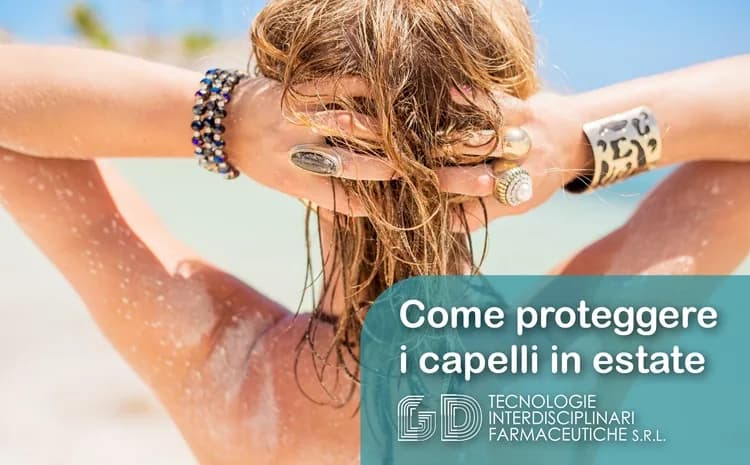
Summer: tips to protect dry and oily hair
Sun, salt water, chlorine. In summer our hair is exposed to many elements that can damage it. Find out how best to protect it
Summer is certainly the most eagerly awaited season of the year, with its long sunny days that invite relaxation and fun. Between a dip in the pool, a stroll along the seafront and a hike among lakes and waterfalls high in the mountains, however, we often forget that at this time of year our hair needs some extra care.
We are increasingly aware that we should use protection all year round to prevent sun damage to our skin.
But our hair is at risk too.
Prolonged exposure to the sun, sea salt, pool chlorine, humidity and heat can make our hair brittle, dry and dull, or turn it into a heavy, sticky tangle because of excess sebum.
Whatever your hair type, it is essential to adopt a proper protection and care routine during the summer months. Protecting your hair is not just about appearance, but also about the health of the scalp and preventing long-term damage.
In this article, we will explore the different factors that can damage hair in summer and offer valuable tips and advice on how to effectively protect oily and dry hair in order to keep your hair healthy and radiant during the hottest season of the year.
Sun damage to dry and oily hair
One of the main enemies of our hair in summer is the sun, whose harsh rays can cause varying degrees of damage to the hair.
Let's look specifically at the dangers of the sun for dry hair and for oily hair.
Sun and dry hair
If not properly protected, dry hair can be weakened by the sun. UV rays can in fact damage the cuticle, the outer layer that protects the cortex, penetrating deeply and thus affecting the very structure of the hair, which loses its natural elasticity.
The result?
The classic “straw” effect, with brittle, damaged hair, making it more prone to breakage.
And if you have recently dyed your hair, you will certainly end up with faded colour, because sunlight can break down the pigment molecules inside the hair.
Sun and oily hair
We always hear about dry, damaged, frizzy and dehydrated hair after long summer days in the sun.
But those struggling with seborrhoea also have to deal with the harmful effects of UV rays. Prolonged exposure to solar radiation can in fact upset the balance of the scalp and worsen this condition, triggering a series of specific problems for people with oily hair.
The activity of the sebaceous glands in the scalp is stimulated and intensified by the great heat, which consequently encourages the production of more sebum, the natural oil that moisturises the hair.
Under normal conditions, sebum forms a protective layer that keeps hair moisturised and protected, helping to lubricate and waterproof the hair shaft, which becomes stronger and more resilient.
But when the glands produce too much of it, sebum builds up on the hair and scalp, making them look oily, greasy and dirty.
The effects of salt water on hair
Dry hair and sea salt: guaranteed dehydration
If you have dry hair, you will certainly have noticed: when you come back from a day at the beach, your hair looks worse.
It is duller, more damaged and more dehydrated.
It was not only the sun that ruined it. Sea water, which we so enjoy diving into after spending hours tanning on the beach, also helps to damage our hair. Salt water can in fact strip natural moisture from the hair, robbing it of shine and softness and making an existing dryness problem worse.
Oily hair and sea salt: benefits but also risks
Oily hair, on the other hand, seems to benefit from the sea.
In fact, sea salt has a degreasing effect and can have a purifying action on the scalp, thanks to its ability to absorb excess sebum.
Be careful not to overdo it, though.
Salt water can also irritate the scalp and trigger a reaction in the sebaceous glands, pushing them to produce more sebum as a form of protection.
Swimming in the pool? Watch out for chlorine: it does not make your hair fall out, but…
According to a false myth about hair loss, still very widespread, chlorine can cause baldness.
This chemical, dissolved in pool water to disinfect it, is actually not responsible for hair loss.
However, this does not mean it is completely harmless to our hair. Quite the opposite.
Chlorine is known for its ability to strip the natural oil from the hair and scalp. Although this action can be beneficial for oily hair, since it can help reduce sebum and rebalance the scalp, in the long term it can lead to a feeling of dehydration.
On dry hair, however, this dehydrating effect is immediate, leaving it more brittle.
In addition, as we saw with salt water, chlorine can irritate the scalp, especially if it is used in high concentrations or if the hair is exposed to it for long periods.
In oily hair, the irritation caused by chlorine can activate the sebaceous glands, pushing them to produce even more sebum as a defence mechanism and leading to greasier hair.
How not to ruin your hair in summer: tips to protect it
If you have read this far, you will have realised that no hair is immune to the harmful effects of sun, salt water and chlorine, which together are a truly lethal mix for all hair types, both dry and oily.
So, if we want to enjoy our holidays without coming back perfectly tanned but with ruined hair, it is a good idea to take a few small precautions to preserve the health and beauty of our hair.
Let's see which ones.
- Limit sun exposure: As we have seen, UV rays can cause considerable damage not only to our skin but also to our hair. So try to avoid direct exposure during the most intense and hottest hours of the day, usually between 10:00 and 16:00. At other times, wear a wide-brimmed hat or a scarf that can filter solar radiation and limit its effects.
- Rinse after swimming: After a swim in the pool or the sea, always rinse your hair with fresh water to remove chlorine or salt. This should be done using a shampoo specifically for dry or oily hair, depending on your hair type.
In case of excessive dryness, we recommend Tricodin Shampoo Capelli Secchi e Sfibrati, our specific treatment for hair that needs extra pampering after the stress of exposure to sun, sea and/or chlorine. Thanks to the moisturising, emollient and soothing properties of its active ingredients, Tricodin Shampoo Capelli Secchi e Sfibrati helps hair regain its natural shine, leaves it soft and silky and protects it from sun damage.
In case of seborrhoea, on the other hand, we recommend Tricodin Shampoo Capelli Grassi which, thanks to its special formulation based on Canadian Willowherb, has a rebalancing action on the scalp: it soothes redness and irritation while acting on excess sebum, normalising its production. - Use the hairdryer as little as possible: During the summer, let your hair dry naturally, without using hairdryers, straighteners or curling irons. The tools we usually use to dry and style our hair the way we like put it under strong heat stress that can damage it. It is better, then, to pat your hair with a towel to remove excess moisture and make the most of the warm summer air.
- Trim your hair regularly. As we wrote in an article on false myths about hair loss, cutting your hair often will not make it grow faster. However, it is good practice to go to the hairdresser regularly for a trim to get rid of split ends, which (as well as making hair look neglected and unhealthy) can travel up the hair shaft and help weaken it.
- Follow a balanced diet: Our health also depends, above all, on what we put on our plates. What we eat affects our physical condition, our skin and our hair too. A balanced diet rich in nutrients such as vitamins, proteins and minerals is essential for keeping hair healthy and strong, not just in summer but all year round. Make sure you eat foods that support the health of your hair and scalp, such as fresh seasonal fruit and vegetables, lean proteins and omega-3 fatty acids.
Please note:
Information provided for informational purposes only, which cannot constitute a diagnosis, the prescription of a treatment, or a substitute for a direct relationship with your doctor or a specialist visit. We always recommend asking for the advice of your own doctor and/or specialists.
For any reports or complaints, please contact the owner of this website at the email address gdtif@gditalia.biz