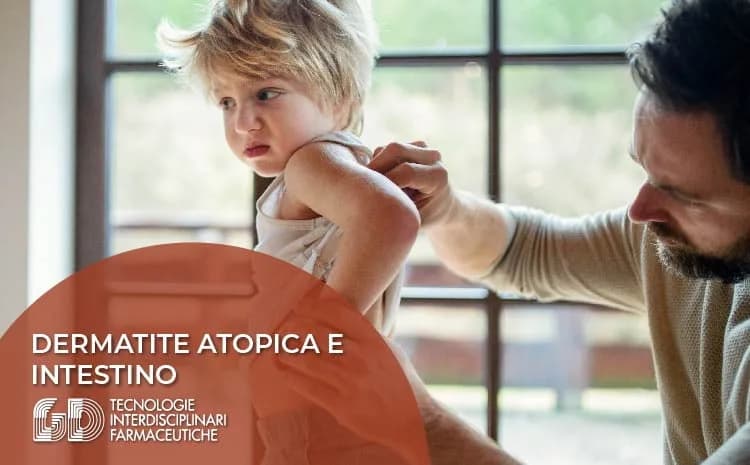
Atopic dermatitis and the microbiota: the gut-skin axis
Atopic dermatitis and the microbiota: the gut-skin axis
Atopic dermatitis and the gut microbiota: on the face of it, these two concepts seem very far apart.
The first is a chronic inflammatory skin disease, which flares up on contact with even minimal irritants, with symptoms such as dryness, skin rashes and intense itching.
The second, on the other hand, is the community of microorganisms, mostly bacteria, that live inside our gut.
Could there be a link between them?
The short, direct answer is: yes, what happens in our gut can have repercussions on the health of our skin. As several studies and research projects have shown, there is a direct link between an imbalance in the gut microbiota (so-called dysbiosis) and atopic dermatitis.
Let's look at what this means.
The influence of the gut microbiota on the immune system
We need to start from the idea that the gut is not simply an organ responsible for digestion and nutrient absorption.
This is only one of its many functions.
It is able to filter the substances we take in through our diet, protecting our body from external attacks.
The bacteria that make up our gut microbiota, together with the epithelial cells and mucus, form the intestinal barrier, which works selectively: it lets nutrients and beneficial substances through while blocking infectious and potentially pathogenic agents, allergens and harmful substances, which are expelled.
But the gut microbiota is also essential for the development and functioning of our natural defences, right from birth.
How?
Thanks to the bacteria and viruses it is made of, it can gather information about the external agents we come into contact with during the first months of life and pass it on to our still immature immune system, teaching it to respond appropriately to different stimuli.
Thanks to this constant interaction, our defences learn to protect us from potential attacks, keeping us safe from infections and making us less susceptible to disease.
In addition, the gut microbiota produces molecules that modulate our immune response, making it stronger and more reactive.
But what does all this have to do with atopic dermatitis?
When the balance breaks down: systemic inflammation and atopic dermatitis
Several studies have shown that patients with atopic dermatitis have an altered gut microbiota, whose composition is heavily skewed in favour of “bad” bacteria such as Clostridia, Clostridium difficile, Escherichia coli which get the upper hand over the healthy population.
This imbalance appears to play an important role in the onset of the inflammatory skin disease because it leads to greater permeability of the intestinal barrier.
The “bad” bacteria, in fact, secrete substances that can damage the intestinal walls and compromise their integrity: their essential filtering function suddenly fails, leaving the door open to infectious and pathogenic agents that can enter the blood and gain uncontrolled access to our body through the bloodstream.
All this triggers a chain reaction, because the immune system reacts promptly to the invasion, activating our defence systems.
This is how inflammation flares up, quickly becoming systemic.
All this predisposes to the onset of atopic dermatitis and can help worsen this and other skin conditions, such as acne.
The limits of traditional cortisone-based treatment for dermatitis
These are the reasons why traditional treatment for atopic dermatitis involves applying cortisone creams or, in more severe cases, taking oral corticosteroids.
Cortisone is an immunosuppressant, able to inhibit the immune response and therefore relieve inflammation, keeping symptoms such as itching under control.
Although they are fairly effective and widely used, unfortunately these treatments do not provide a cure. Atopic dermatitis is in fact a complex, multifaceted disease with a chronic course, alternating phases of remission and flare-ups.
Because of its side effects, cortisone can only be used for short periods.
In recent years, however, thanks to studies and research, new proposals for intervention and therapeutic approaches that go against the trend have been emerging.
Rather than trying to inhibit the immune response, it is possible to support and stimulate our defences so that they counter the disease appropriately.
Acting systemically: AVEC INTEGRATORE
Over the years, GD Tecnologie Interdisciplinari Farmaceutiche has also wanted to contribute to research, developing a line of products to support the treatment of atopic dermatitis.
This is the Avec line:
- Avec crema, soothing and emollient, able to bring relief and comfort to dry, fragile skin suffering from chronic irritation, dermatitis and other skin hyperreactivity;
- Avec detergente mousse, a soft foam that cleanses the skin gently, restoring hydration and helping to repair the altered hydrolipidic barrier typical of skin affected by atopic dermatitis;
- Avec emulsione fluida, a product suitable for reactive, sensitive skin that brings relief and protects against irritants. It can also be used to dilute medicines such as cortisone creams and ointments, which are then delivered and absorbed more easily by the skin;
Recently, these products have been joined by another one that can meet the needs of atopic and hyperreactive skin, with a systemic approach, in line with the most recent findings.
This is our Avec Integratore.
AVEC is a food supplement formulated with plant-based actives, vitamins and minerals such as:
CERAMOSIDES FROM TRITICUM AESTIVUM
HYALURONIC ACID 50KDA (LOW MOLECULAR WEIGHT)
VIOLA TRICOLOR WHICH HELPS IMPROVE THE BODY'S PURIFYING FUNCTIONS AND SKIN WELLBEING
PERILLA AND ASHWAGANDHA WHICH IMPROVE THE BODY'S NATURAL DEFENCES.
ASHWAGANDHA ALSO PROMOTES RELAXATION AND MENTAL WELLBEING
VITAMIN A, BIOTIN AND ZINC CONTRIBUTE TO THE MAINTENANCE OF HEALTHY SKIN
VITAMIN D, COPPER, VITAMIN A AND ZINC CONTRIBUTE TO IMPROVING THE NORMAL FUNCTIONS OF THE IMMUNE SYSTEM
COPPER ALSO CONTRIBUTES TO THE MAINTENANCE OF NORMAL CONNECTIVE TISSUES WITH SWEETENER
Please note
Information provided for informational purposes only, which cannot constitute a diagnosis, the prescription of a treatment, or a substitute for a direct relationship with your doctor or a specialist visit. We always recommend asking for the advice of your own doctor and/or specialists.
For any reports or complaints, please contact the owner of this website at the email address gdtif@gditalia.biz