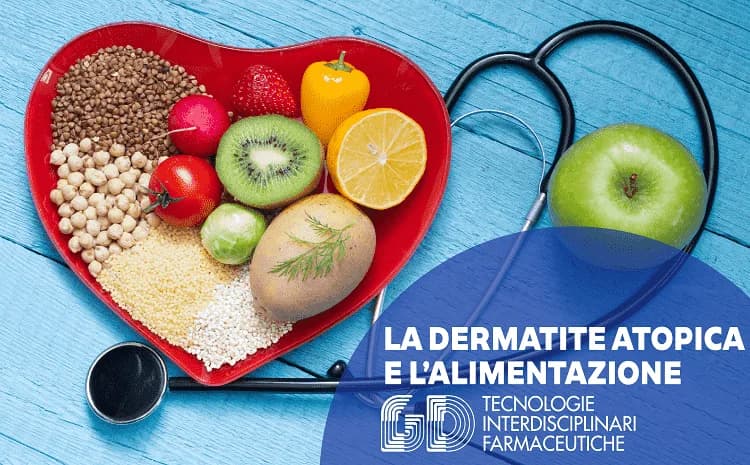
Atopic dermatitis and diet
Does diet affect atopic dermatitis? Which foods should you avoid and which should you favour? Here are the answers to your questions
Flare-ups, red patches, dry and itchy skin that makes you scratch, with the risk of increasing the inflammation rather than finding relief. For people with atopic dermatitis, every day means dealing with very unpleasant symptoms that undermine their physical and mental wellbeing.
Based on their own subjective experience, some patients believe that this condition can be triggered, or at least made worse, by eating certain foods.
In reality, however, atopic dermatitis is not a food allergy, but a multifactorial disease. This means that the origin of this skin condition cannot be traced back to a single cause.
Atopic dermatitis is caused by a combination of concurrent factors: structural abnormalities of the skin, infectious and environmental agents, and immune dysregulation.
Atopic dermatitis and food allergies
With that in mind, it can be said that there are no foods that must be completely excluded from your diet if you suffer from atopic dermatitis. Before cutting a food from your table, you should rather undergo specific tests, allergy tests to check whether or not you are intolerant to that particular food.
Several studies have in fact shown that atopic dermatitis is often (but not always) associated with food allergies.
In particular, around 40% of infants and children with atopic dermatitis have an IgE-mediated food allergy.
This allergy can be considered an alteration of the body's immune response, which reacts abnormally and excessively to substances that are harmless in themselves but are interpreted as harmful. When it comes into contact with these substances, the body produces specific IgE antibodies (class E immunoglobulins) that attack healthy cells, triggering the allergic reaction.
This, in turn, can trigger or worsen the symptoms of atopic dermatitis through urticaria and the release of histamine.
Histamine and allergic reactions
Histamine is a chemical mediator, in other words a substance that allows messages to pass between cells. It is naturally present in our body and is found above all in the cells involved in immune and allergic responses.
In people with atopic dermatitis, the histamine contained in foods can exacerbate symptoms.
For this reason, it is often advisable to avoid foods that contain high concentrations of histamine or that are histamine-releasing, meaning they encourage our body to release histamine.
Foods rich in histamine include:
- Cheese
- Red wine
- Spinach
- Fresh and tinned tomatoes
- Preserves
- Sausages and cured meats
- Tinned meat
- Beer
- Fermented foods
- Yeast extract
Foods that cause histamine to be released in the body:
- Seafood
- Preserved fish
- Nuts (walnuts, cashews, hazelnuts, almonds)
- Crustaceans
- Chocolate
- Alcoholic drinks
- Milk
- Eggs
- Fruits such as pineapple, bananas, strawberries and papaya
When itching is very intense, it would be wise to limit your intake of these foods, so as to keep the symptoms of atopic dermatitis from getting worse.
Atopic dermatitis and the gut microbiota
In recent years, research and studies have found that the gut microbiota of people with atopic dermatitis (AD) differs significantly from that of healthy people.
It is the collection of micro-organisms (bacteria, fungi, yeasts and viruses) that live and multiply in our gut, and which in the past was also called bacterial flora or intestinal flora.
It is involved in a wide range of biological processes.
For example, it plays a part in digestion, breaking down some components of food and allowing us to absorb their nutrients.
But it also works as a barrier capable of filtering substances, protecting us from those that are potentially harmful. In addition, it has a direct influence on our immune system.
This complex ecosystem starts to form even before we are born, inside the mother's womb. It appears that the foetal gut starts to be colonised as early as halfway through pregnancy. Later on, various environmental factors can influence the composition of this ecosystem, such as stress, pollutants, etc.
Diet also influences our gut microbiota.
In people with atopic dermatitis, the gut microbiota is altered and unbalanced because of the presence of a greater number of "bad" bacteria (such as Escherichia coli) compared with "good" bacteria.
This state of imbalance, known as dysbiosis, causes an increase in the permeability of the intestinal barrier which, in turn, activates the immune response.
This is why, for many years now, when atopic dermatitis is diagnosed, therapies have been proposed that include taking probiotics, which are thought to reduce the severity of symptoms and inflammation.
Avec integratore: the most complete answer to atopic dermatitis
So far we have talked about the more traditional approach to atopic dermatitis.
We at GD, however, wanted to go beyond this approach.
Atopic Dermatitis is in fact a complex, multifaceted condition, which can have very serious consequences for a person's wellbeing
By studying the problems of hyper-reactive skin closely, we developed an innovative product able to meet all the needs of patients with this chronic skin disease. Instead of focusing on a single aspect, we wanted to address Atopic Dermatitis from different angles, with a holistic vision.
This is how we created Avec Integratore, the 100% vegan food supplement formulated as systemic support for the needs of atopic skin and in all situations where the skin barrier is altered, reduced or compromised.
We know that a key feature of hyper-reactive and atopic skin is dryness, which is linked to greater fragility and permeability of the skin barrier, our skin's natural defence. This means that the skin is more exposed to external aggressors.
Avec Integratore acts directly on skin dryness thanks to its ceramoside-based formulation, helping to restore the natural function of the skin barrier.
In this way, the supplement can counteract the onset of symptoms such as redness and severe itching, relieving the discomfort caused by Atopic Dermatitis.
But that's not all.
Atopic Dermatitis is a condition that has an impact on a person's psychological wellbeing and that is partly sustained and worsened by stress and anxiety.
If you suffer from Atopic Dermatitis, you will have noticed that the constant discomfort makes you nervous and restless. Perhaps you are one of those who, unfortunately, cannot sleep peacefully because you keep waking up due to itching that gives you no respite. And in the morning, when you have to get up, you feel you have not rested at all. You feel tired and drained, and these unpleasant sensations add up, accentuating the symptoms of Atopic Dermatitis.
It is a vicious circle that Avec Integratore can help you break.
Its formulation in fact contains an extract of Withania somnifera, a highly effective natural remedy against nervousness, anxiety and low mood.
In addition, Avec Integratore contains active ingredients with antibacterial and antiviral action, which help reduce the risk of infections and superinfections, which are very common because of scratching lesions.
For any reports or complaints, please contact the owner of this website at the email address gdtif@gditalia.biz