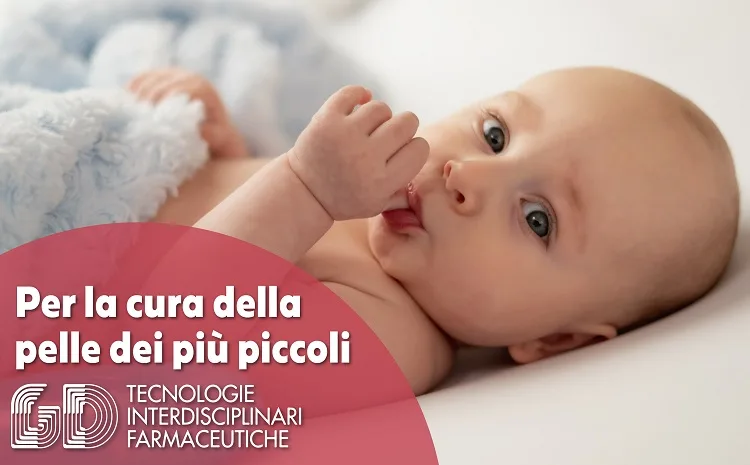
Caring for the skin of newborns and children
Little ones' skin is thin and delicate and prone to many problems such as nappy rash. Find out how to take care of it
Children's skin and adults' skin
Children's skin is more delicate than adults' skin. What causes us no discomfort at all can trigger very strong irritation in little ones.
This is due to some quite significant structural differences.
Let's look at them together.
In very young children, the outermost layer of the epidermis (stratum corneum) is extremely thin. The cells that make it up are not yet bonded together to form a cohesive, resistant structure.
In addition, in the first weeks of life, the sebaceous glands do not yet work properly. As a result, they cannot produce an adequate hydrolipidic film, the invisible mantle that envelops our skin and keeps it well hydrated.
This means that little ones' skin tends to lose water and become dehydrated more quickly, becoming dry.
Another characteristic of infant skin is the lack of a protective acid mantle determined by pH. Newborns' skin, in fact, has an almost neutral pH, which changes very slowly in the weeks after birth.
In addition, young children's skin produces little melanin. This substance synthesised by our body does not only determine the colour of the skin, eyes and hair.
It also serves to protect us from the damage caused by solar radiation.
That is why little ones should never be exposed to the sun except for very short periods and at the coolest times of day, that is, early in the morning or in the evening when the sun is setting.
All these characteristics mean that children's skin is particularly sensitive to attacks from external agents and prone to various kinds of irritation.
Skincare products for children: which to choose?
As we have seen, children's skin is thin and permeable. This means that it has little resistance and easily lets in the substances it comes into contact with, absorbing them.
This is another reason to choose gentle products, ideally based on natural ingredients, tested and safe for the most sensitive skin.
Read the label carefully and watch out for:
- aggressive surfactants
- petrolatums (paraffin, mineral oils, petroleum jelly)
- silicones
- cleansers containing fragrance
These substances, widely used in the production of everyday cosmetics, can prove irritating for little ones' delicate skin. It is best to avoid them as far as possible.
Skin problems in newborns and young children
Nappy rash
One of the most common problems faced by parents of newborns and infants is nappy dermatitis, or nappy rash.
The main symptoms of this skin complaint typical of children who still wear nappies are redness, burning and swelling of the skin in the genital area, on the bottom and on the upper thighs.
It is a genuine erythema or skin rash, quite painful for the little one, which in the most severe cases can even lead to sores and ulcers.
Causes of nappy rash
The irritation is caused by a series of concurrent factors.
The nappy clinging to the child's body prevents air from passing through and does not let the skin breathe. Inside it, the newborn's delicate skin is in close contact with urine and faeces, which contain irritating substances that can macerate the skin and damage the already weak skin barrier.
On top of this there is the mechanical rubbing of the nappy itself on the baby's skin.
In addition, the particular warm, humid environment inside the nappy also encourages the proliferation of bacteria and fungi that can attack the child's skin and cause secondary infections such as candida or impetigo.
Preventing and treating nappy rash
Knowing how to care for little ones' skin helps prevent skin problems such as nappy rash.
There are some good rules to always keep in mind to prevent this complaint and minimise the risk of the newborn developing rashes.
First rule for the hygiene and health of children's skin: change the nappy often.
It does not matter whether it is a washable nappy or a disposable one. When the newborn or infant is soiled, they should be changed as soon as possible to prevent fluids from stagnating.
On average, the nappy should be changed every 2-3 hours.
Before changing it, always make sure you have washed your hands well, then proceed, using only lukewarm water to rinse.
Use a neutral cleanser only if necessary and no more than two or three times a day.
Among GD products, we recommend ISODERMA, a balanced, soap-free neutral cleanser, with soothing aloe vera. A concentrate of gentleness and delicacy, hypoallergenic and fragrance-free, suitable for early childhood.
After carefully washing the nappy area, pat dry gently with a soft cloth, avoiding rubbing.
If you are out with your child, you can also use wet wipes for their hygiene. But remember always to choose alcohol-free and fragrance-free wipes, as these ingredients could prove irritating.
A useful tip from dermatologists and paediatricians is to apply a barrier cream such as EUTRODIN soothing and protective cream to the affected area; it spreads like a light veil over little ones' skin, providing extra protection against irritants.
It contains zinc oxide, a natural soothing agent with anti-inflammatory and antiseptic properties that calms redness and soothes irritation. This makes it suitable for chronic dermatoses, such as those caused by urine stagnating in young children's nappies.
Whenever possible, it is a good idea to let the child's skin breathe by exposing it to the air. This reduces the harmful effects of constant rubbing against the materials the nappy is made of.
In case of severe irritation or secondary infection, it is advisable to see your trusted paediatrician for a thorough check-up, so that they can make a diagnosis and prescribe the most suitable treatment, to be followed carefully.
Chapped skin in newborns and young children
In the popular imagination, newborns' skin is rosy, silky and soft.
And yet, during your baby's first days of life, you have noticed that their skin is often dry and chapped, and tends to flake and peel off, especially on the hands and face.
There is absolutely no need to worry: what you are seeing is completely normal.
To explain what is happening, we need to remember that until recently this baby was safe in the mother's womb, completely surrounded by amniotic fluid and covered with "vernix caseosa", a substance that protects the skin of the foetus from constant contact with water.
When the baby is born, the vernix caseosa, which no longer serves any purpose, disappears. The newborn's skin is therefore left unprotected, exposed to contact with the air.
The most superficial layer starts to crack, flake by flake, making way for a more resistant layer, although one that is still very delicate.
We could almost say that newborn babies shed their skin.
This natural process is not painful and causes the baby no discomfort.
To soften the skin in areas where it looks chapped, you can apply a moisturiser suitable for little ones or an oil. To avoid aggravating the dehydration typical of infant skin, it is advisable not to overdo baths.
Keep them short and use lukewarm water.
Atopic dermatitis
Another skin complaint typical of newborns and very young children is atopic dermatitis or atopic eczema, a skin disease due to an alteration of the skin barrier, which causes dry skin (xerosis), inflammation and intense itching.
It follows a cyclical course, alternating phases of remission (during which the symptoms ease until they disappear completely) with flare-ups of the condition.
Symptoms of atopic dermatitis generally begin to appear at around 2 or 3 months of age and get worse when the affected area of the body is rubbed or scratched.
The problem can persist for a long time, but atopic dermatitis usually tends to regress and heal spontaneously as the child grows.
The onset of the condition cannot be traced back to a single cause, but is linked to a combination of concurrent factors such as genetic predisposition and environmental factors.
Managing this situation can be complicated for parents, especially if the little patient with atopic dermatitis is only a few months or a few years old.
At present, in fact, there is no cure for atopic dermatitis. Rather, we can talk about treating the symptoms. The treatment to be used must be prescribed by a doctor after careful assessment of the case.
For cleansing little ones' atopic skin, we suggest using Avec Cleansing Mousse, a light, soft foam that spreads gently over the skin, nourishing and hydrating it while removing every trace of dirt and impurities. A simple gesture that gives a pleasant feeling of wellbeing and cleanliness.
For any reports or complaints, please contact the owner of this website at gdtif@gditalia.biz