Caring for oily hair: how to beat the grease
Oily hair that looks dirty and greasy soon after every wash? Discover the causes and the remedies for hair that always looks its best
Dealing with oily hair is not at all pleasant. Despite washing it constantly, you always feel it is dirty and this probably makes you uncomfortable. You feel embarrassed by how greasy and oily it looks, by the way it sticks flat to your head even if you shampooed it only the day before, and you are always afraid others will notice.
You should know, though, that you are not alone.
Dozens of men and women do as you do, searching online for answers to their questions. Above all, they look for the most effective remedies and the most suitable products to look after their hair, such as shampoos and conditioners specifically for treating oily hair.
This article can give you plenty of important information to solve your problem. We will look into the causes, finding out together why hair tends to get greasy, what precautions to take to stop it getting dirty so easily and which products to use to keep it clean for longer, limiting its oiliness.
The causes of oily hair
What gives hair a greasy, oily look is sebum, an oily substance produced by the sebaceous glands of the scalp.
Under normal conditions, sebum has a very specific function: it keeps hair hydrated and protected, lubricating and waterproofing the hair shaft and making it stronger and more resistant. At the same time, sebum forms a protective mantle that defends the scalp against attack from external agents.
However, in some situations, our glands secrete an excessive amount of sebum, which builds up on the scalp and on our hair, making it look dirty and weighed down by grease. Very often, this already unpleasant situation is made worse, and even more embarrassing for those affected, by the presence of dandruff.
What causes this excess sebum that leads to oily hair?
The causes can be of various kinds, and may also occur together:
- hormonal imbalances and genetic predisposition
- stress
- washing too often
- using the wrong or overly harsh products
- poor eating habits
Hormonal imbalances and oily hair
Teenagers are often the ones who suffer from oily hair.
The bodies of young people in full development are subject to major hormonal imbalances linked to the onset of puberty, which brings a series of physiological changes.
This applies to both boys and girls.
Boys experience the effects of a dramatic rise in testosterone that stimulates the sebaceous glands and consequently leads to marked sebum production, with the appearance of acne and oily hair
In girls, something similar happens due to progesterone, whose levels rise following the first periods, with clear consequences for the scalp, which on those days of the month tends to get greasy more quickly.
In women, oily hair can occur whenever there are hormonal fluctuations:
- around the time of menstruation
- after stopping the contraceptive pill
- during pregnancy
- with the onset of menopause
Stress and oily hair
Greasy hair a day after washing? One of the causes could be the stress you put yourself under, caught up in a daily whirlwind of countless commitments and deadlines.
Small doses of stress help keep us active, giving us a jolt.
But at high levels stress has a wide range of consequences for our health, affecting the hair and scalp too.
When we are under too much strain, our body releases large amounts of cortisol, which stimulates the activity of the sebaceous glands.
The result?
Stress acne and oily hair.
Oily hair: washing it every day does not solve the problem
If you have oily hair, you have surely found yourself washing it almost every day, trying to keep it clean for more than 24 hours in a row.
As we have seen, however, oily hair is not a sign of poor hygiene or neglect, but a condition resulting from many different factors, including hormonal ones.
Washing oily hair frequently does not solve the problem; on the contrary, it risks amplifying it and making it worse.
When we cleanse our hair and scalp, we stimulate the glands, which will produce more sebum to replace what we removed by washing.
So what should you do?
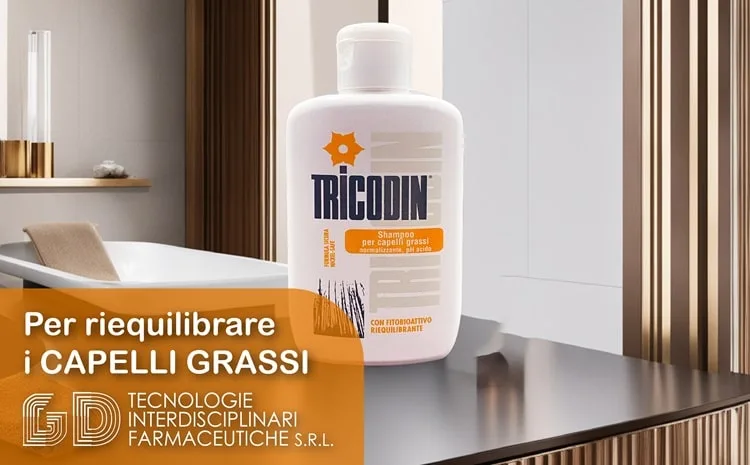
It is better to wash less often, always using specific treatment products such as Tricodin Shampoo Capelli Grassi, formulated to act only on excess sebum, normalising the pH of the scalp and preventing hair from quickly becoming greasy again.
The wrong hair products and hyperseborrhoea
The products you choose for cleansing and styling your hair can also be behind a problem of hyperseborrhoea and dandruff.
Some shampoos on the market contain waxes and silicones that can weigh hair down and clog the roots, preventing the scalp from breathing.
Others, sold as degreasing, can be too harsh on the skin, which defends itself precisely by covering itself with an oily film of sebum.
Others still are too rich and therefore too nourishing for your hair type.
These are usually foaming shampoos, that is, ones that produce a lot of lather.
Eating habits and oily hair
As we often say, what we eat affects our health in every way.
The diet we follow determines the balance of our gut microbiota (better known as bacterial flora), the set of microorganisms that colonise our gut.
If the microbiota is balanced, we feel well.
If, on the other hand, dysbiosis occurs, problems begin, affecting not only our gastrointestinal system but the whole body, including skin and hair.
Alteration of the gut and skin microbiota, in fact, can lead to seborrhoea, with an increase in sebum production.
Preventing sebum build-up on the hair. Answers to questions about oily hair
Having looked in detail at the causes of oily hair, we would like to answer the most common questions on the subject, with some tips on caring for it the right way so you can go back to showing off your hair proudly, without any more worry or embarrassment.
How should you wash oily hair properly?
People with oily hair often wonder how they should wash it to get a satisfying, long-lasting result, without having to get back in the shower the very next day.
The first rule is: do not overdo it.
It is best to stick to 2, at most 3 shampoos a week, alternating a treatment shampoo with a gentler product, without irritating the scalp:
- For treatment, we suggest using Tricodin Shampoo Capelli Grassi, which deeply cleanses hair that is dirty and weighed down by sebum, also acting on the redness and itching linked to seborrhoea. Its formulation is enriched with Canadian Willowherb, a plant that grows at the foot of the great trees of Canada's forests, a natural anti-grease ingredient and an effective remedy against free radical damage.
- For frequent use, you can choose Tricodin HF, gentle, nourishing, moisturising and soothing, with vitamins H and F, which promote healthy skin and hair and help against redness and flaking.
Putting too much stress on your hair is counterproductive.
Washing it every day, or almost, to degrease it means stripping it of its natural hydrolipidic film, a protective layer needed to keep it hydrated and healthy, which puts the sebaceous glands on alert so they get to work even harder to make up for what is missing.
We also recommend spreading the product with a light massage, with a gentle, light touch, without rubbing too hard. This step, which can also be done before shampooing, has many advantages:
- it helps remove excess sebum and rebalance its production
- it promotes microcirculation, stimulating hair growth
- it relieves stress, which does no harm
While washing, pay attention to the water temperature. Rinsing with cold water is not ideal because it cannot remove dirt and residual traces of product, which stay on the hair and can weigh it down and make it dull.
But you should not use water that is too hot either, as you risk triggering a rebound effect, stimulating the sebaceous glands and undoing all your efforts to keep oily hair under control.
Choose the happy medium, setting the thermostat to get lukewarm water.
Once you have finished cleansing, we recommend applying Tricodin Balsamo restructuring and smoothing conditioner, with rice extract, liquid crystals and silk proteins, to gently detangle and restore the hydro-sebaceous balance.
Drying is also a key step when it comes to managing oily hair properly. As with washing, you need to control the temperature, holding the hairdryer at least 20 centimetres from your head so that hair and scalp are not exposed to too much heat.
Which ingredients should you avoid in products for oily hair?
The products used to care for oily hair can make the difference between an excellent result and a real disaster.
That is why it is good to know how to read labels so you can choose the most suitable ones, avoiding those that could be harmful.
What are the ingredients that should not be in a good shampoo for oily hair?
- Harsh surfactants because they dehydrate the scalp and trigger a reaction from the sebaceous glands
- silicones, which create a film on the hair, preventing natural hydration and transpiration
It is better to opt for products based on natural ingredients that respect the skin's pH.
What should you eat to improve the health of oily hair?
Since diet also affects the health and appearance of our hair, we want to end this article with a few general pointers.
The first tip is to bring fresh, vitamin-rich foods to the table, with plenty of seasonal fruit and vegetables.
In particular, green foods such as broccoli, artichokes and asparagus can be excellent allies against seborrhoea because they naturally contain folic acid, which stimulates growth and volume, helping hair regenerate.
It is also a good idea to include pulses in your diet (peas, lentils, beans), which are rich in B vitamins that counteract the formation of excess sebum on the scalp.
We would also add rice, wholegrain cereals that provide fibre, extra virgin olive oil, fish and white meat (unless you follow a vegan diet).
Other foods should be avoided or eaten in moderation:
- milk and dairy products, because they increase the fat in your diet and are linked to an increase in circulating testosterone in the blood
- cured meats
- fried foods
- fatty meats
- rich filled cakes, snacks and packaged products, which contain a high percentage of sugars
- salt
A correct, balanced diet can also be combined with supplementation: we suggest taking Plenum Integratore, based on tyndallised lactic ferments, FOS and Zinc.
Please note
Information provided for informational purposes only, which cannot constitute a diagnosis, the prescription of a treatment or a substitute for direct contact with a doctor or a specialist visit. Always ask your doctor and/or specialists for advice.
For any reports or complaints, please contact the owner of this website at gdtif@gditalia.biz