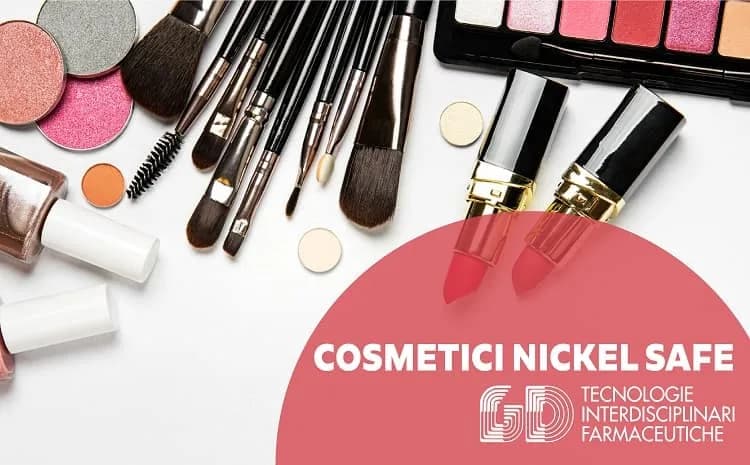
Nickel safe cosmetics. For the safety of your skin
Nickel safe cosmetics. For the safety of your skin
Avoiding nickel seems an impossible task.
Traces of this heavy metal can be found almost everywhere. It occurs naturally in the soil. Many items of jewellery, especially costume jewellery such as earrings, bracelets, necklaces and piercings, are made of metal alloys that also contain nickel.
Invisible and insidious, nickel is also used in the manufacture of a great many everyday objects: keys, coins, pans and batteries.
Finally, high concentrations of nickel are also found in some foods that are a normal part of our diet, from cocoa to whole grains.
An interesting curiosity concerns its name.
It was discovered in 1751 by Baron Axel Fredrik Cronstedt. He wanted to try extracting copper from another mineral, now known as niccolite. But purely by chance, he extracted an element that no one had ever seen before.
He decided to call it nickel.
The word comes from Kupfernickel, the name miners had given to niccolite.
Kupfernickel literally means "copper imp" (from Kupfer, meaning "copper", and Nickel, a diminutive of the name Nikolaus). Those who went down the mines with shovel and pickaxe, on coming across niccolite, thought that a sort of evil goblin had turned the copper into this strange mineral.
In theory, it is a completely harmless material. Yet a great many people develop a genuine nickel allergy, with symptoms that can be very disabling and have a strong impact on the daily lives of those affected.
Nickel allergy: forms and symptoms
Nickel allergy presents as a disproportionate reaction of the immune system to an element foreign to the body, with which it interacts through the skin or through food.
Essentially, it is a mistake by our defence system, which responds inappropriately to an external stimulus, triggering the allergic reaction.
When the skin of an allergic person comes into contact with an object containing nickel, a skin rash usually breaks out. The skin turns red, with burning and itching. Small fluid-filled blisters may also form, leading to small scabs.
These are the typical symptoms of allergic contact dermatitis, very similar to those of eczema.
The rashes can last from 2 to 4 weeks. In the most severe cases, these lesions can develop into actual ulcerations.
In a certain number of people, eating certain foods containing large amounts of nickel can cause a very varied range of symptoms, with gastrointestinal, neurological and respiratory complaints:
- nausea
- bloating and abdominal cramps
- diarrhoea or constipation
- headache
- a feeling of exhaustion
- dizziness and vertigo
- headache
- rhinitis
- asthma
In this case, it is called Systemic Nickel Allergy Syndrome (SNAS).
Diagnosing nickel allergy
- If you notice that your skin becomes red and swollen when you wear earrings
- If you have a strange skin reaction when handling stainless steel pots and pans
- If you cannot apply certain cosmetics without experiencing discomfort such as itching and burning
Then you may have a nickel allergy. If you suspect something of this kind, our advice is always to consult an experienced dermatologist who can assess the condition of your skin and carry out an accurate test to reach a diagnosis.
The dermatologist will give you a patch test, which is carried out precisely to establish whether the interaction of a particular substance with our body causes allergic reactions.
It is a completely painless test. To carry it out, a patch containing the allergen to be assessed, in this case nickel, is applied to the skin of the back. The patch is not removed for at least 48 hours, during which the allergen is slowly released.
After 48 hours, the doctor can remove the patch and "read" the test, checking whether there have been skin reactions such as erythema or oedema and how severe they were, whether mild or serious.
Taking medicines could affect the results. Patients should therefore always tell their dermatologist if they are undergoing treatment, particularly if they are using antihistamines or corticosteroids.
The patch test makes it possible to diagnose any skin allergy that appears as contact dermatitis.
Diagnosing Systemic Nickel Allergy Syndrome (SNAS) is more complex and first involves a period on a restrictive low-nickel diet, in which the offending foods are eliminated.
Next, the patient undergoes the oral provocation test, an allergy investigation that must always be carried out by an expert. The patient is asked to take the allergen, first in extremely low doses, increasing the amount at regular intervals, usually every 30 minutes. This continues until allergic symptoms appear or until a standard amount is reached.
The right cosmetics for people with nickel allergy
European regulations prohibit the use of nickel in the formulation of cosmetic products.
However, this ban does not fully protect people who suffer from nickel allergy.
Although it is in effect banned as an ingredient, nickel is still present in low concentrations in creams and other beauty and skincare products, because it is a residue of the manufacturing process.
In short, because of the production processes themselves, it is impossible for there to be no traces of nickel in the cosmetics sold on the Italian market.
At present, there are no procedures or machines that can completely eliminate these residues or impurities, which can come from certain raw materials, such as pigments.
As a result, the wording "nickel free" found on some labels is not strictly correct.
It would be better to use the expression "nickel tested", to indicate that the specific product has been tested for nickel content and is safe even for people who are allergic or intolerant to this element.
At GD we prefer to use yet another expression, which we feel is more accurate: "nickel safe".
All our products are in fact made with certified nickel-free raw materials and are specifically tested at the end of each production run and at the end of packaging, so as to rule out any contamination at the various stages. In this way we guarantee consumers maximum skin tolerability.
Tests are carried out in external laboratories on every production batch using ICP/MS, and products are distributed only when the amount of nickel detected is below 0.0001%.
This amount is 10 times lower than the level considered legally acceptable and represents the safety threshold for people with nickel allergy, as stated by the Italian National Institute of Health (Istituto Superiore di Sanità), which says:
"on irritated skin of sensitised subjects, with a 48H occlusive test, over 90% of subjects do not react to concentrations below 1 ppm".
The aim of our work is to promote people's health, for men and women alike.
Health that starts with the skin.
For any reports or complaints, please contact the owner of this website at gdtif@gditalia.biz